
8 Remember the sabbath day, and keep it holy. 9 Six days you shall labor and do all your work. 10 But the seventh day is a sabbath to the LORD your God; you shall not do any work—you, your son or your daughter, your male or female slave, your livestock, or the alien resident in your towns. 11 For in six days the LORD made heaven and earth, the sea, and all that is in them, but rested the seventh day; therefore the LORD blessed the sabbath day and consecrated it. Exodus 20:8-11 NRSV
What do you see? (OBJECTIVE OBSERVATION)
Let us challenge ourselves, shall we? Let‘s make sure we don’t get too literal here, because if we do, in the case of THIS painting we might say we see…
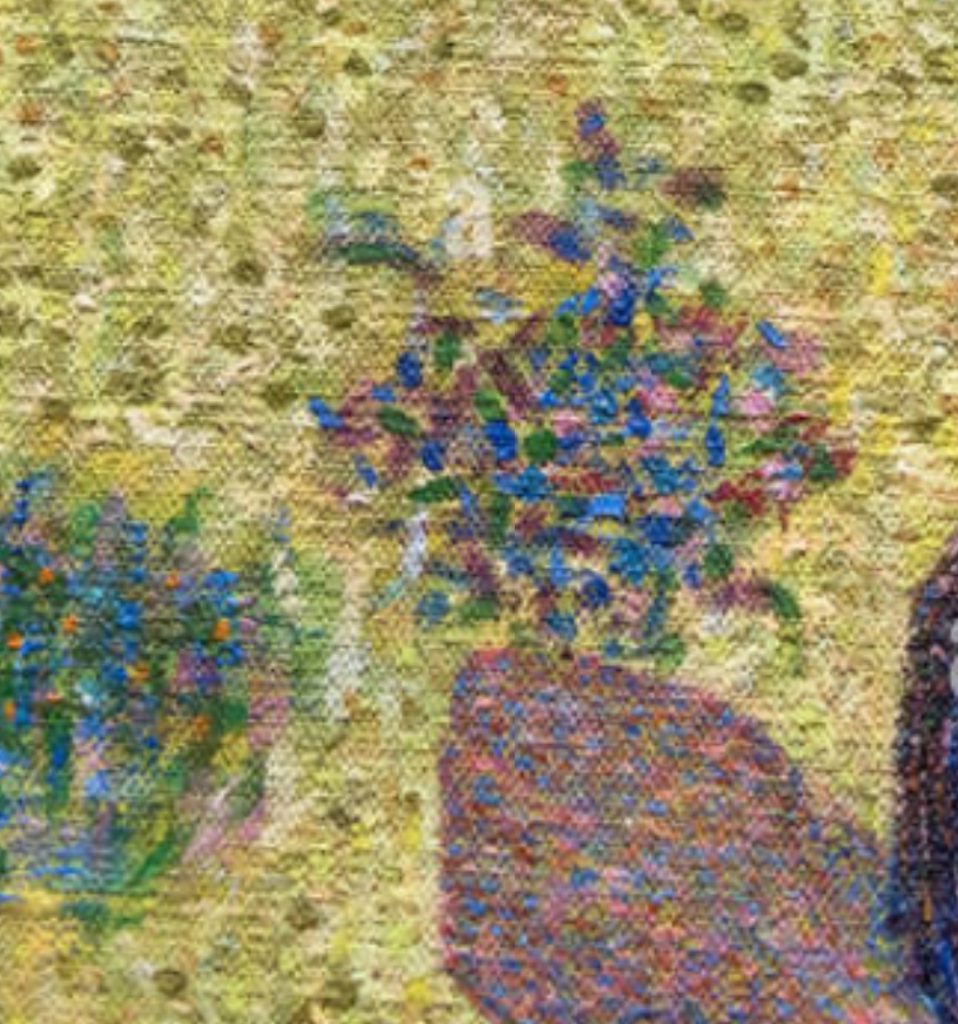
DOTS. Lots of colorful dots of paint. Red and yellow and blue and green and brown and ….
Can you find these dots in the painting above?
But we’re not being THAT literal. So what do you see in the painting. Look it over, think about what you see in this painting.
Click on the top painting to take a closer look. The dots of paint combine optically in the human eye to perceive single shades or hues. They are precisely placed to form this painting.
We may see many different people relaxing in a park by the river. On the right, a fashionable couple, the woman with the sunshade and the man in his top hat, are on a stroll. On the left, another woman who is also well dressed extends her fishing pole over the water. There is a small man with the black hat and thin cane looking at the river, A few dogs, far away one white dog has a brown head, a woman knitting, a man playing a trombone, two soldiers standing at attention as the musician plays, and a woman hunched under an orange umbrella. The artist also painted a man with a pipe, a woman under a parasol in a boat filled with rowers, and a couple admiring their infant child.
Some of the characters are doing curious things. The lady on the right side has a pet monkey on a leash. Almost everyone here is caught in a still pose, except for the child in the orange dress skipping off into the trees, the man on the far left playing trombone, and the furious little dog at the lower right. Many people are in the shade, either under parasols, or under trees.
One more thing to observe, that is unusual about this painting. There is a border around the whole painting, created in contrasting color so as to stand out.
What do you feel? (SUBJECTIVE EMOTION)
Does the painting make you feel anxious and excited, or is it calming? Is there a restful feeling about this painting?
Do you feel curious or intrigued by the style and method of the painting and the way the artist used many dots of paint to “fool your eye” into seeing people and objects?
Do you want to join these folks in their enjoyment of the park, maybe to stroll along with them, to listen to the music or watch what is going on in the river?
What do you wonder about?
What is the name of this painting? “Un dimanche après-midi à l’Île de la Grande Jatte” which is French and translates in English to A Sunday Afternoon on the Island of La Grande Jatte.
Who is the artist? Georges-Pierre Seurat, known as Georges Seurat. He lived from 1859 to 1891 and lived in Paris, France. He was a French post-Impressionist1 artist, and his developed painting techniques gave form to Neo-Impressionism2.
When was this painted? The work was painted from 1884-1886, with several studies having been done during that time. The completed work is 6.6 ft by 9.8 ft and is composed of millions of dots of paint of uniform size, carefully placed on the canvas. Seurat was impressed by the color theories of Chevreul3, Rood4 and others, and adapted this scientific research into his paintings. This form of painting is called Pointilism5.
Where is the Island of La Grande Jatte?6 The island is located in the Seine river at the gates of Paris. In the late 1800’s the island was a place of resting and recreation, a place for Parisian society to leisurely enjoy on Sunday, their day off.
Most everyone in the painting has their gaze off to the left, watching something in the river. Whose gaze is directed differently? Look for the girl in the white dress. Who is she looking at? Is it the observer of the painting? Are we being invited to join everyone in relaxing at the park?
What about the edge of the painting? After painstakingly painting this beautiful scene, why did Seurat paint a contrasting frame around it? The painting, for the 1886 exhibition, had a white frame, something then unusual for exhibited art. The stark contrast between the pointillism of the painting and the white frame was something Seurat wanted to soften, so he added the contrasting border of pointillist colors for this reason.
Georges Seurat died at the relatively young age of 317. He left us with a wealth of engaging art and a new perspective on how we look at the world.
What do you think?
1 Again he entered the synagogue, and a man was there who had a withered hand. 2 They watched him to see whether he would cure him on the sabbath, so that they might accuse him. 3 And he said to the man who had the withered hand, “Come forward.” 4 Then he said to them, “Is it lawful to do good or to do harm on the sabbath, to save life or to kill?” But they were silent. 5 He looked around at them with anger; he was grieved at their hardness of heart and said to the man, “Stretch out your hand.” He stretched it out, and his hand was restored. 6 The Pharisees went out and immediately conspired with the Herodians against him, how to destroy him. Mark 3:1-6 NRSV
What do we do on any given Sunday? Do we work? Do we play? Do we worship? Do we serve others? Father Patrick van der Vorst says, “All four Gospels highlight the significance of the Sabbath, a day of rest and worship deeply rooted in Jewish tradition. Jesus, as a faithful Jew, observed the Sabbath and emphasized its importance, but He also redefined its purpose. In Mark’s Gospel reading, Jesus heals a man on the Sabbath, challenging the Pharisees’ rigid interpretation of the Law. They had turned the Sabbath into a day of burdensome rules rather than one of joyful worship and service to God. Jesus reminds us that the Sabbath is meant to restore, heal, and bring life, not impose unnecessary restrictions. For Christians, this principle translates to Sunday as our day of worship and rest, where we honor God through the Eucharist and community worship.”8
In today’s society (as possibly back in the late 1800’s) people are constrained in ways that prevent them from keeping Sunday as a day of rest and worship. But we can still be mindful, and find alternate ways to keep God’s commandment. Is there another day of the week that you find time to “rest and worship”? Is there a day (or day’s) that you can act in service to someone, the way Jesus did, helping someone in need? Maybe you volunteer in a soup kitchen, or deliver Meals on Wheels to shut-ins. Possibly you work at a thrift store, whose proceeds go to mission work. Some take an annual opportunity to work on housing for the needy through groups like Habitat for Humanity. Others might be available for disaster assistance work throughout the world when needed. All of these things might impact your regular sabbath day of rest and worship, but it is still honoring God in the world.
What do you think about the Sabbath? What do you think about “A Sunday Afternoon on the Island of La Grande Jatte”? Share your thoughts in the comment area below.
Footnotes and further reading
- https://en.wikipedia.org/wiki/Post-Impressionism ↩︎
- https://en.wikipedia.org/wiki/Neo-Impressionism ↩︎
- https://en.wikipedia.org/wiki/Michel_Eug%C3%A8ne_Chevreul#Chevreul’s_work ↩︎
- https://en.wikipedia.org/wiki/Ogden_Rood#Legacy ↩︎
- https://en.wikipedia.org/wiki/Pointillism ↩︎
- https://en.wikipedia.org/wiki/%C3%8Ele_de_la_Jatte ↩︎
- https://en.wikipedia.org/wiki/Georges_Seurat#Death ↩︎
- https://christian.art/daily-gospel-reading/mark-3-1-6-2025/ ↩︎