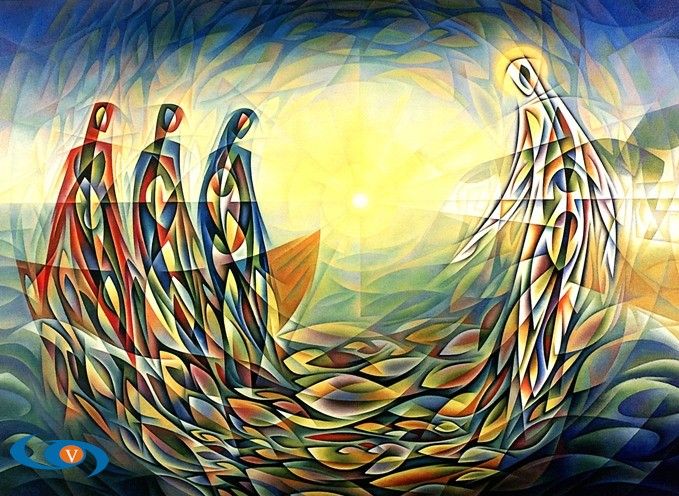
“Children, do you have any fish?”
Click on the above image for a larger version
What do you see? (OBJECTIVE OBSERVATION)
We see a circular, radiating structure. The artist builds the composition around a central circle, read as the sun, with shards of color rippling outward like water rings on the sea. The effect feels kaleidoscopic, facets of bright color assembling into a unified whole. The painting has a luminous effect similar to a stained glass window.
On the left, three figures are huddled in a boat. Their forms are with sweeping, rhythmic lines and “patchwork” colors. They appear to be pulling up nets, filled with fish. On the right, a tall, elongated figure stands, glowing white, possibly on the shore.
The water is depicted through overlapping, scale-like shapes of fish in blue, teal and green, suggesting the movement of waves without using traditional realism. The fish shapes aren’t just in the “water” or the nets, they integrate into the forms of the three on the left and the one on the right, possibly tying or connecting them together. The geometric shapes wrap around above as well as below, in more pale, pastel-like colors, completing the connection between the figures in a circular shape.
A central, radiant sun-like orb sits between (and behind) the boat and figures, casting a golden light.
The style has a mandala-like geometry, and is certainly more impressionistic than naturalistic.
What do you feel? (SUBJECTIVE EMOTION)
As you look at this painting, think about the way it makes you feel. Do you easily recognize the figure, the boat, the landscape? Or are you struggling to make sense of the image? Are the colors pleasing and harmonious, or are they jarring and disturbing? Do you feel drawn into the painting, or is it keeping you away? Do you feel the artist has created a pleasing image, one that might be suitable in your home, work-place, or place of worship?
What do you wonder about?
As we often do, we wonder about the title of the work and the name of the artist. We wonder if our first impressions about the piece are correct. Is this about Jesus and his disciples, many of whom were fishermen?
The painting is called “The Miraculous Draught of Fishes” or “The Miraculous Catch” and was painted in 1978. The artist is John Reilly (1928 – 2010)1, an English oil painter and potter who focused primarily on Christian themes. John and his wife, Elspeth Henderson, set up a pottery studio on the Isle of Wight. Reilly specialized in distinctive, brightly colored ceramics, mainly plaques and tiles using subtle, jewel-like colors and geometric patterns. As he developed his own painting style he incorporated the jewel-tones, and tile-like patterns into his work as very distinctly his own. Additionally (possibly inspired by the potters turning wheel), many of his paintings have a circular motif, with patterns revolving around some central focal point.
What story is Reilly capturing in this painting? There are several scripture passages where Jesus, walking along the sea shore, talks to his disciples. Matthew 4: 18-22, Mark 1:16-20, and Luke 5:1-11 all tell the story of Jesus calling his disciples to “fish for people”. But in John 21:1-14, Jesus appears to the disciples after he is resurrected.
1 After these things Jesus showed himself again to the disciples by the Sea of Tiberias; and he showed himself in this way. 2 Gathered there together were Simon Peter, Thomas called the Twin, Nathanael of Cana in Galilee, the sons of Zebedee, and two others of his disciples. 3 Simon Peter said to them, “I am going fishing.” They said to him, “We will go with you.” They went out and got into the boat, but that night they caught nothing.
4 Just after daybreak, Jesus stood on the beach; but the disciples did not know that it was Jesus. 5 Jesus said to them, “Children, you have no fish, have you?” They answered him, “No.” 6 He said to them, “Cast the net to the right side of the boat, and you will find some.” So they cast it, and now they were not able to haul it in because there were so many fish. 7 That disciple whom Jesus loved said to Peter, “It is the Lord!” When Simon Peter heard that it was the Lord, he put on some clothes, for he was naked, and jumped into the sea. 8 But the other disciples came in the boat, dragging the net full of fish, for they were not far from the land, only about a hundred yards off.
9 When they had gone ashore, they saw a charcoal fire there, with fish on it, and bread. 10 Jesus said to them, “Bring some of the fish that you have just caught.” 11 So Simon Peter went aboard and hauled the net ashore, full of large fish, a hundred fifty-three of them; and though there were so many, the net was not torn. 12 Jesus said to them, “Come and have breakfast.” Now none of the disciples dared to ask him, “Who are you?” because they knew it was the Lord. 13 Jesus came and took the bread and gave it to them, and did the same with the fish. 14 This was now the third time that Jesus appeared to the disciples after he was raised from the dead. John 21:1-14
Reilly has depicted Jesus as glowing, adorned in white. Although there are not 7 disciples in the boat, as described in the scripture, these are clearly disciples fishing. And while there may not be 153 fish in the nets in this painting, there are clearly so many that the nets are full.
Why 153? This number is rich in symbolism. Mathematically, 153 is the sum of all the whole numbers from 1 to 17 (1+2+3+…+17 = 153). Seventeen itself has symbolic resonance, seen as a prime number representing the Messiah. Some scholars believe that, at the time John’s Gospel was written, there were thought to be 153 nations in the known world.
Father Patrick van der Vorst says, “In other words, the miraculous catch is a sign that Christ came for everyone, to draw all peoples and nations to himself. But this universal mission unfolds one person at a time… one fish at a time. Just as Jesus stood on the shore in today’s passage, inviting his disciples to cast their nets, so we too are called to stand at the water’s edge of people’s lives. inviting, encouraging, and gently leading them to God.” 2
The fish, in the painting, flow from Jesus to the disciples in the boat, indicating blessings flow from Christ and God, to us. The rainbow colors of the fish indicate the diversity of those who are caught in the net by the disciples of Jesus.
What do you think?
Let me know what you think of this painting. It is neither realistic, not abstract, but rather a form of stylized Expressionism3. “[Expressionism]’s typical trait is to present the world solely from a subjective perspective, distorting it radically for emotional effect in order to evoke moods or ideas”. Expressionist artists have sought to express the meaning of emotional experience rather than physical reality. There seems to certainly be a lot of emotional experience going on here. What are you feeling when you look at this painting? (Revisit step 2.) What do you think the artists feelings were? Do you think they are similar to your feelings?
John Reilly has four paintings in the Methodist Collection of Modern Art. There is a book “The Painted Word”4 which has collected 50 of Reilly’s paintings and his thoughts on each.
Reilly says, about his paintings, “My paintings are not concerned with the surface appearance of people or things, but try to express something of the fundamental spiritual reality behind this surface appearance. I try to express in visible form the oneness and unity of this invisible power, binding all things into one whole. I try to express something of the universal and timeless truths behind the stories of the Bible.“
Dwell on this for a moment. What do you think about his approach to painting? About this approach to understanding the Bible and the teachings of Christ? Does this painting make the scriptural story it represents more approachable? Feel free to comment below.