Not Your Average Joe

“Whoever follows me will never walk in darkness but will have the light of life”

What do you see? (OBJECTIVE OBSERVATION)

It is a very dark room. In it there is a man with a leather apron using an auger to drill a hole in a piece of wood. And a boy, watching, holding a candle for light. They are looking at each other, not at the woodworking.

The candle brightly lights the boys face, and slightly lights the man’s. The candle light also shines through the boy’s fingers, making them slightly translucent.

What do you feel? (SUBJECTIVE EMOTION)

If this is a father and son, or even just a master and apprentice, I feel a fondness between the two. I can feel the attention the boy is paying to the man, and I feel that the man is attentive to the boy, more so than to his woodworking. Notice the way the man is looking at the boy. There seems to be an affection between the two, and I am drawn into that feeling of affection. I like these two, and the personal moment they are having. What do you feel?

What do you wonder about?

Who are these two? Why do they work in the dark? And why is the boy holding the candle that lights their work and illuminates their faces?

The painting is called “Joseph the Carpenter” and was painted in 1642 by Georges de la Tour1 (1593-1652). He lived in Lorraine, in what is now part of France. His paintings had a pronounced preference of dark and light (chiaroscuro2). While he was recognized during his lifetime (known as “Painter to the King” of France) his work quickly became obscure after his death. It was rediscovered in 1915 by Herman Voss3.

But what of this painting? If it is called “Joseph the Carpenter”, is that Joseph, husband of Mary and father to Jesus? And then is that boy Jesus?

That is, in fact, what de la Tour is presenting to us here.

Little is known, scripturally, about Joseph. He was a descendant from David, as documented by Matthew.

16 and Jacob the father of Joseph the husband of Mary, of whom Jesus was born, who is called the Messiah. Matthew 1:16

and Luke.

23 Jesus was about thirty years old when he began his work. He was the son (as was thought) of Joseph, Luke 3:23

The angel of the Lord spoke to Joseph.

“Joseph, son of David, do not be afraid to take Mary as your wife, for the child conceived in her is from the Holy Spirit. 21 She will bear a son, and you are to name him Jesus, for he will save his people from their sins.” Matthew 1:20-21

Which he obeyed.

He is mentioned in Matthew, Luke and John, noting that he was a carpenter, and that he protected Mary and brought her to Bethlehem for the census, wherein Jesus was born. He found them shelter in a stable when Mary was ready to give birth.

He further protected Mary and Jesus when Herod was seeking to destroy Jesus.

14 Then Joseph got up, took the child and his mother by night, and went to Egypt, 15 and remained there until the death of Herod.
Matthew 2:14-15

Then after the danger, Joseph returned to Israel with his family and settled in Nazareth.

19 When Herod died, an angel of the Lord suddenly appeared in a dream to Joseph in Egypt and said, 20 “Get up, take the child and his mother, and go to the land of Israel, for those who were seeking the child’s life are dead.” 21 Then Joseph got up, took the child and his mother, and went to the land of Israel. 22 But when he heard that Archelaus was ruling over Judea in place of his father Herod, he was afraid to go there. And after being warned in a dream, he went away to the district of Galilee. 23 There he made his home in a town called Nazareth, so that what had been spoken through the prophets might be fulfilled, “He will be called a Nazorean.” Matthew 2:19-23

That is about it. But what can we further understand about Joseph? We can know that he was a good father and husband. He stood up for Mary at a time when she could have easily been abandoned, ostracized or even stoned to death. He protected his family when it was in grave danger, fleeing to a foreign country for safety. He worked hard as a carpenter, providing for his family.

Luke tells us that Jesus was brought to Jerusalem to be presented to the Lord at the temple, sacrificing “a pair of turtledoves or two young pigeons.” (Luke 2:24), indicating that they were a poor family. Further they were amazed when old Simeon blessed them, for he was guided by the Spirit to witness the Messiah.

And when Jesus was 12, Luke tells us, his parents went up to Jerusalem for the Passover festival. When Jesus was overlooked and left behind, Mary and Joseph returned, frantically looking for him, finding him in the temple “sitting among the teachers, listening to them and asking them questions. And all who heard him were amazed at his understanding and his answers.”

Some of that was holy knowledge, but undoubtedly, some of that was parental guidance, support and teaching. Joseph would have been part of that.

And also Joseph, we can know, was pious and devout. When the messenger of the Lord spoke to him, he obeyed their direction, trusting in the love and goodness of God.

One other thing we can try to understand about Joseph as a father figure is his relationship to Jesus’ brothers, as mentioned in Scripture. Whether he was the biological father of James, Joses, Simon and Jude is a debate many Biblical historians and scholars have had over the years. But undoubtedly, if Joseph were alive while they were growing up, Joseph would have cared for them in the same way that he cared for Mary and Jesus.

So, what does this painting by Georges de la Tour say to us? Christian art analyst, Father Patrick van der Vorst, says “Georges de La Tour’s Joseph the Carpenter is a quietly powerful reflection. At first glance, the scene appears simple: the young Jesus stands beside his earthly father, who is working by candlelight in a darkened room.”4

It is noticed that the auger, being held and turned by Joseph, has a cruciform shape, implying a foreshadowing of Christ’s crucifixion.

It is also noticed that the candlelight “symbolizes Christ as the Light of the World”.

“The overall quietness and intimacy of the scene reflect the domestic holiness of the Holy Family, while also drawing our attention to the sacredness of ordinary work. Joseph, absorbed in his craft, embodies the dignity of labor, showing how daily tasks can become acts of devotion,” says Father van der Vorst.

Ordinary work. Is that how Joseph viewed protecting, providing for and teaching Jesus? Can our daily work be so directed? Can we nurture our families the way Joseph nurtured Jesus? Can we provide for and protect our children and our spouse?

And more importantly, whether we have a spouse or whether we have children, can we protect and nurture one another with fatherly love?

What do you think?

Take a moment to meditate on the scriptural passages about Joseph, while looking at de la Tour’s painting. What do you think about this work? Is it reflective of the relationship Joseph and Jesus might have had (from what we can discern from scripture)?

Share your thoughts with us in the comments below.

  1. https://en.wikipedia.org/wiki/Georges_de_La_Tour ↩︎
  2. https://en.wikipedia.org/wiki/Chiaroscuro ↩︎
  3. https://en.wikipedia.org/wiki/Hermann_Voss_(art_historian) ↩︎
  4. https://christian.art/daily-gospel-reading/john-3-31-36-2025 ↩︎

Trashing Art

I am approaching this post differently from my ususal layout. We’re going to talk about ICONOCLASM which, for us, is appropriate, because what addresses the conjunction of FAITH and ART more than destroying art for your beliefs?

First, we should define a few things.

What is an ICON? With regard to religious images, “An icon (from Ancient Greek εἰκών (eikṓn) ‘image, resemblance’) is a religious work of art, most commonly a painting, in the cultures of the Eastern Orthodox, Oriental Orthodox, Catholic, and Lutheran churches. The most common subjects include Jesus, Mary, saints, and angels. Although especially associated with portrait style images concentrating on one or two main figures, the term also covers most of the religious images in a variety of artistic media produced by Eastern Christianity, including narrative scenes, usually from the Bible or the lives of saints.”1

This is a classic definition, and there are many texts that discuss the history of religious icons and the denominations that venerate them.

Other modern uses of the term “icon” include:

  • (in computing) an image used in a graphical interface.
  • (cultural icon)
    • (Pop icon) a celebrity, character, or object whose exposure in pop culture constitutes a defining characteristic of a given society or era
    • (Architectural icon) a groundbreaking or unique building
  • a pictogram

But we are disregarding these latter definitions in this discussion. We will be sticking to “religious work of art” definition, even though we may be extending it past the Byzantine era into our modern era. And may even apply it to some non-religious art, where it is impacted by “Iconoclasm”.

What is ICONOCLASM?
“The belief in the importance of the destruction of icons and other images or monuments, often for religious or political reasons. Those who engage in or support iconoclasm are called iconoclasts.”2 Iconoclasm does not generally encompass the destruction of the images of a specific ruler (or military figure) after their death or overthrow. For example, the defacing and vandalism of the tomb of my ancestor Baron Ralph Neville3 would not be considered iconoclasm.

Christian icons began to be created an venerated as early as the second century. (Some legends claim that Pilate had an image of Jesus created, but this has been largely debunked).

The image of Christ Pantocrator (Almighty) was one of the first images of Christ developed in the Early Christian Church and remains a central icon of the Eastern Orthodox Church. The oldest known surviving example of the icon of Christ Pantocrator was painted in encaustic on panel in the sixth or seventh century.

The Icon of Christ and Abbot Mena  is a Coptic painting on wood and was found in the Apollo monastery in Bawit, Egypt. It is dated to the second half of the 6th century

Andrei Rublev (c. 1360 – c. 1430) was a Russian artist considered to be one of the greatest medieval Russian painters of Orthodox Christian icons and frescoes. The only work authenticated as entirely his is the icon of the Trinity (c. 1410)

These are some of the most iconic (something that is seen as a cultural icon) icons created throughout the East. There were many more, but a significant number have not survived. Why is that? While early Christian churches venerated the created images of Jesus and the saints as a means of drawing people into closer relationship with God and Christ, there began to be rumblings in the Eastern Orthodox churches about the use of icons as being idolatrous.

You shall not make for yourself an idol, whether in the form of anything that is in heaven above, or that is on the earth beneath, or that is in the water under the earth. Exodus 20:4

Do not turn to idols or make cast images for yourselves: I am the LORD your God. Leviticus 19:4

you shall drive out all the inhabitants of the land from before you, destroy all their figured stones, destroy all their cast images, and demolish all their high places. Numbers 33:52

“Cursed be anyone who makes an idol or casts an image, anything abhorrent to the LORD, the work of an artisan, and sets it up in secret.” All the people shall respond, saying, “Amen!” Deuteronomy 27:15

Since we are God’s offspring, we ought not to think that the deity is like gold, or silver, or stone, an image formed by the art and imagination of mortals. Acts 17:29

The early Christian church Synod of Elvira endorsed iconoclasm with the canon “Pictures are not to be placed in churches, so that they do not become objects of worship and adoration.”4 Early church theologians cited scripture from the Pentateuch (the first five books of the Jewish and Christian Scriptures) as justification for, at the least removing, and at the most destroying, images of Jesus and the saints. The justification was that images (sculptures as well as paintings) might be venerated to the point of becoming idols, which Mosaic law strictly prohibits.

What do you think about sacred images being idolized? Do you carry a prayer card with Warner Salman’s “Head of Christ” in your wallet or purse? Do you bow or kneel at a statue of Mary? Do you wear a medal of a saint, praying to it for aid or intercession? These things may or may not be idolatrous, but Eastern Orthodox Christians of the Byzantine Era would say so, and would seek to destroy them.

My thoughts on this, while understanding the dangers of idolatry and the potential for making an image more important than God or Christ, I agree with the artist Rene Magritte when he painted “The Treachery of Images” as a statement that “Art is not ‘the thing’. Only the thing is the thing.”.5

The Byzantine Era of iconoclasm

The Byzantine Empire was the Eastern most part of the Roman Empire and survived the fall of the Roman Empire in the 5th century . It existed from 306 to 1453 CE. Christianity was the state religion. There were two periods in the Byzantine Empire where iconoclasm was a predominant expression of the Christian Church. The First Iconoclasm, as it is sometimes called, occurred between about 726 and 787, while the Second Iconoclasm occurred between 814 and 842. According to the traditional view, Byzantine Iconoclasm was started by a ban on religious images promulgated by the Byzantine Emperor Leo III the Isaurian, and continued under his successors. It was accompanied by widespread destruction of religious images and persecution of supporters of the veneration of images.6

Throughout the era the Byzantine Empire was regularly in contact with other Arab nations, either through war or trade. Islamic iconoclasm may or may not have had an impact on the Eastern Christian church and their iconoclasm. Islamic iconoclasm went further and rejected any depictions of living people or animals, not only religious images. This is evident in Islamic architectural design, where no vines, leaves, flowers, birds or animals adorn structures, only geometric designs. This is called Aniconism.

A mid 9th century Psalter illustration shows John the Grammarian rubbing out a painting of Christ with a pole and sponge, similar to the one offered to Christ on the cross.

By the end of the 9th century, Byzantine Iconoclasm was fading. But it certainly was not the end of iconoclasm.

Protestant Reformation Iconoclasm

In the early 1520’s, reformers called for the removal of images from churches. Martin Luther argued that the mental picturing of Christ when reading the Scriptures was similar in character to artistic renderings of Christ.

Calvinist reformers encouraged the removal of religious images, resulting in the Bildersturm, roughly translated as ‘attack on the images or statues’. During these spates of iconoclasm, Catholic art and many forms of church fittings and decoration were destroyed in unofficial or mob actions by Calvinist Protestant crowds as part of the Protestant Reformation. Most of the destruction was of art in churches and public places.7

Once the revolt proper had started, there were many instances of clearing churches, some still unofficial and disorderly, but as cities became officially Protestant, increasingly undertaken by official order, altars, to which Calvinists took strong exception, were typically completely removed, and some large churches, like Utrecht Cathedral, were vandalized or covered up.

The pre-Reformation sculpture, Dead Christ was discovered in 1954 beneath the floor of Mercer’s Chapel. The iconoclasts did some damage to the face, but the feet, arms and crown of thorns are gone. 8

20th and 21st century Iconoclasm

While iconoclasm continues on through the years into the 21st century, the nature of the vandalism and destruction of art, while still backed by religious and political beliefs, has shifted focus. Art has become more secular, yet it still reveals something about human faith.

The self portrait of Albrecht Dürer, painted in 1500, presents the artist as Christ. In 1805 it became part of the Bavarian Collection and hangs in  Alte Pinakothek in Munich, Germany. It so distressed an unknown visitor that in 1905 the eyes were gouged out by a hatpin. It has since been restored.

On 10 March 1914 Mary Richardson, a British suffragette, entered the National Gallery in London to attack a painting by Velázquez, the Rokeby Venus, using a chopper she smuggled into the gallery.

She wrote a brief statement explaining her actions to the WSPU which was published by the press:

“I have tried to destroy the picture of the most beautiful woman in mythological history as a protest against the Government for destroying Mrs Pankhurst, who is the most beautiful character in modern history. Justice is an element of beauty as much as colour and outline on canvas.
— ”Miss Richardson’s Statement”. ‘The Times. London. 11 March 1914.

The canvas was later fully restored.9

Some contemporary artists use iconoclasm as a statement about art. In 2018, the anonymous artist Banksy stunned onlookers when he shredded his Girl with Balloon (2006) after it was purchased at Sotheby’s New York. Banksy confirmed that he was responsible for the shredding (by way of a mechanical device he had hidden inside the frame) and gave the altered piece a new name, Love Is in the Bin.

See a video of the auction and shredding here.

Contemporary art destruction

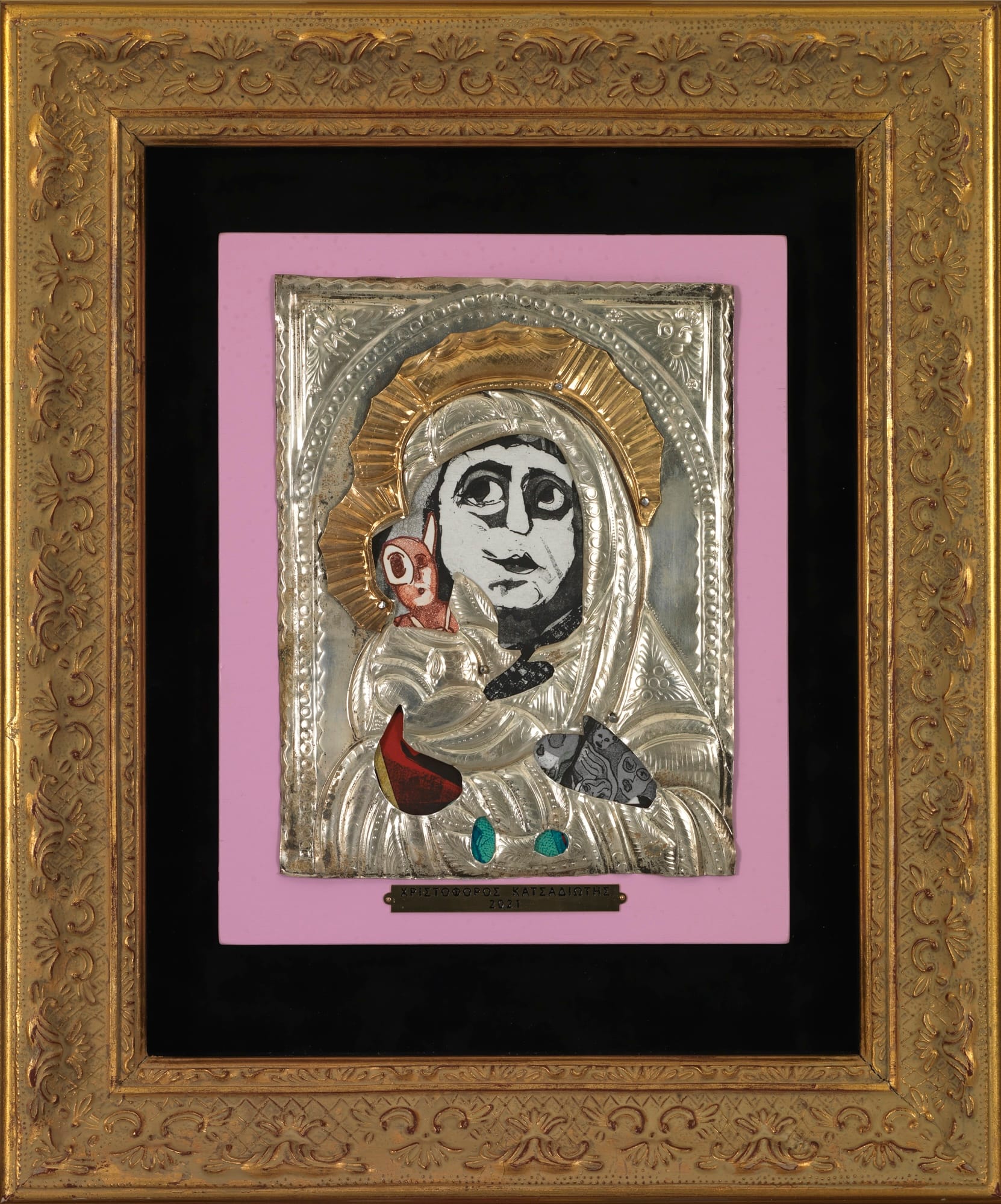
In March of 2025, Greek Parliament Member Nikolaos Papadopoulos targeted and damaged artist Christophoros Katsadiotis’s works, on display at the national gallery in Athens, decrying them as “blasphemous.”

Papadopoulos, a conservative Parliament member representing Greece’s far-right and ultra-religious Niki Party, accessed the group show The Allure of the Bizarre late Monday morning, March 10, and took down four of Katsadiotis’s etchings depicting Saint Christopher, Saint George, the Virgin Mary, and Jesus Christ. Papadopoulos shattered the protective glass of two etchings, claiming that the works slipped from his hands.10

One day after the incident, the artist Katsadiotis stated  that “it is worth considering how society (politics) uses religion as a tool to control and corral the masses with threats, fear and obscurantism.” The museum underscored that it “unequivocally condemns” any act of vandalism, violence, and any attempts at censorship that threaten the freedom of artistic expression.

In August of 2025, following a political decision statewide to remove painted crosswalks on all public streets throughout Florida, a similar directive caused planned and approved sidewalk art in Burns Court, Sarasota to be completely removed without the artists knowledge.

Art that had been commissioned by the city. It was a major tourist draw and attracted artists and culture lovers year round.

While the art itself was not political nor religious, the impetus for removing it was. Beginning with clashes over rainbow painted crosswalks, which showed support for LGBTQ+ issues and rights, the politically conservative legislature and Governor demanded they be removed as “public nuisances”. The removal extended beyond crosswalk art to include any art on surfaces that were walked on or driven on (even if approved by the city or local authority). The artists in Sarasota have filed legal notices against Sarasota and the state of Florida FDOT.11 The art cannot be recovered, but will the artists preserve their right to create public art when commissioned?

What do you think?

What do you think about the destruction of art? Is it justified? Is it ethical? If a work of art goes against your faith beliefs, is it OK to destroy or damage it? How offensive must a work of art be to bring a person to that level of destruction?

What about art in your place of worship? Have you looked around at any of the art that is displayed there? Should it be there, or should it be removed to another location so as to not interfere with your faith and worship?

Is religious art idolatrous, or does it bring you into closer relationship with God? Does religious art inform you in new ways about your faith? Does it challenge you? If a work spoke out in ways that do not conform to your beliefs, or understandings about your faith, should it be removed? Altered? Vandalized? Destroyed?

Does art, of any type, whether sacred or secular, bring value to your faith journey? If it offends you, do you have the obligation (or even the right) to destroy it?

Feel free to express your thoughts in the comment section below.


If you or someone you know would like to receive notification about these posts (about once every 24 days), subscribe at http://eepurl.com/i78iLU
Subscriptions cost nothing but ensure that you know when a new post is published on the website. You can always access the website (even without subscribing), but subscribing helps me know how many people are connecting to my posts, and it is a nice prompt to you to check out the latest. Thank you for following along.


  1. https://en.wikipedia.org/wiki/Icon ↩︎
  2. https://en.wikipedia.org/wiki/Iconoclasm ↩︎
  3. https://en.wikipedia.org/wiki/File:Highly-damaged_tomb_of_Ralph_Neville,_2nd_Baron_Neville_de_Raby_and_his_wife,_Alice_de_Audley,_in_Durham_Cathedral.jpg ↩︎
  4. https://web.archive.org/web/20120716202800/http://faculty.cua.edu/pennington/Canon%20Law/ElviraCanons.htm#:~:text=36.%C2%A0%C2%A0%C2%A0%C2%A0%20Pictures%20are%20not%20to%20be%20placed%20in%20churches%2C%20so%20that%20they%20do%20not%20become%20objects%20of%20worship%20and%20adoration. ↩︎
  5. https://bonafides.kjunkins.com/wordpress/this-is-not-a-pipe/ ↩︎
  6. https://en.wikipedia.org/wiki/Byzantine_Iconoclasm ↩︎
  7. https://en.wikipedia.org/wiki/Beeldenstorm ↩︎
  8. https://www.theguardian.com/artanddesign/2013/oct/06/art-under-attack-tate-review ↩︎
  9. https://en.wikipedia.org/wiki/Mary_Richardson ↩︎
  10. https://hyperallergic.com/athens-museum-removes-artworks-vandalized-by-far-right-lawmaker/ ↩︎
  11. https://www.mysuncoast.com/2026/03/23/sarasota-erased-downtown-art-without-public-notice-artists-now-seek-damages/ ↩︎

Please Pass the Bread

“bread to strengthen the human heart” – Psalms 104:15c

What do you see? (OBJECTIVE OBSERVATION)

A basket, on a table, in a dark place. In the basket, some bread. It’s very realistic and the bread looks good enough to eat.

Pretty simple. Or is it?

Look at the bread. It’s not a whole loaf. Someone has torn off one end. What we see is the “heel” of the loaf. The basket is sitting precariously close to the edge of the table. It seems as though, if someone were to bump it, it would plunge into the darkness.

And something else you may have noticed. In this dark and mysterious space, with only a table, a basket and some bread, there seems to be an unusual light about the whole thing. The light looks as though it is coming from the bread itself. It illuminates the inside of the basket, shines through the woven side, illuminating the table behind the basket. And it casts a shadow on the table next to the basket.

What do you feel? (SUBJECTIVE EMOTION)

Do you hunger for this bread? Are you uplifted by the fine, almost photographic quality of this painting? Do you feel drawn to the light or are you curious to explore the darkness beyond the table? Are you worried that the bread may fall off the table?

Take a moment to meditate on the painting. Listen to your emotions.

What do you wonder about?

Do you wonder, “what is so special about this loaf of bread and basket that the artist should spend so much time painting it in fine detail”? The painting is 13″ x 15″, not quite life sized.

The artist is Salvador Domingo Felipe Jacinto Dalí i Domènech, or as you probably know him, Salvador Dali (1904-1989). He was a Spanish artist known for his iconic moustache that sometimes curled up, and sometimes curled down.

This painting, Basket of Bread, painted in 1945, was not the first (or last) painting of bread that Dali created. It had echoes of an earlier Dali painting, The Basket of Bread painted in 1926. Of bread, Dali wrote in 1945, ““Bread, has always been one of the oldest fetishistic and obsessive subjects in my work, the one to which I have remained the most faithful.” He chose bread as a sort of personal device or emblem, much like his famous moustache. Many of his works feature or include bread.1

Influenced by Cubism and Surrealism and by artist friends Pablo Picasso and Joan Miró, Dali’s work became primarily Surrealist. Surrealism is an art and cultural movement that developed in Europe in the aftermath of World War I in which artists aimed to allow the unconscious mind to express itself, often resulting in the depiction of illogical or dreamlike scenes and ideas.2 The Surrealists, forming in the 1920’s, often used their works to express their philosophical points of view. For example, Magritte’s Treachery of Images states “This is not a pipe” on a painting of a pipe, expressing the artists view of art as a representation, not as the actual thing being represented. In this way art can carry “metadata”, or an additional context, structure, and information beyond the work itself.

In hi works of bread or including bread, Dali often wanted to express bread as the existential sustenance of life. But Basket of Bread had a subtitle that was in contra point to that meaning. Rather Death than Shame is a reference to “honor suicide”. The bread—a mere heel, and therefore seemingly at the end of its usefulness and life—is perched on the edge of the table against a bleak black backdrop as if on the precipice of its own self-inflicted demise.3 Coincidentally (or maybe intentionally) the completion of this work occurred simultaneously to the suicide of Adolf Hitler.

Dali’s homeland, Spain, suffered through a civil war (1936-1939) followed immediately by World War II (1939-1945). The ravages of the wars created an impoverished situation for the people of Spain. Many families were starving, and the essential sustenance, bread, was clearly on everyone’s mind. To paint the left-over end of a loaf of bread, precariously balanced on the edge of a table, is to highlight the importance of this life giving food, and how precarious life is in regards to bread. Bread later took on renewed significance when it was used as a central image for the Marshall Plan, symbolizing the rebuilding of Europe through shared resources—bread becoming a sign of restoration and hope.

But Dalí also invites us to contemplate something far deeper: the presence of Christ, the Bread of Life, shining in a world overshadowed by darkness.4

Consider bread as a symbol of life (and hospitality) in the Old Testament, and as a symbol of salvation in the New Testament. There are over 330 mentions of bread (or Manna) in the Bible.

Exodus 16:15 When the Israelites saw it, they said to one another, “What is it?” For they did not know what it was. Moses said to them, “It is the bread that the LORD has given you to eat.

Genesis 18:5 (Abraham said,) Let me bring a little bread, that you may refresh yourselves, and after that you may pass on—since you have come to your servant.”

John 6:35 Jesus said to them, “I am the bread of life. Whoever comes to me will never be hungry, and whoever believes in me will never be thirsty.

Matthew 4:3-4 The tempter came and said to him, “If you are the Son of God, command these stones to become loaves of bread.”
But he answered, “It is written, ‘One does not live by bread alone,
but by every word that comes from the mouth of God.’ ”

Matthew 14:19-21 Then he ordered the crowds to sit down on the grass. Taking the five loaves and the two fish, he looked up to heaven, and blessed and broke the loaves, and gave them to the disciples, and the disciples gave them to the crowds. And all ate and were filled; and they took up what was left over of the broken pieces, twelve baskets full. And those who ate were about five thousand men, besides women and children.

Matthew 26:26 While they were eating, Jesus took a loaf of bread, and after blessing it he broke it, gave it to the disciples, and said, “Take, eat; this is my body.”

These are just some of the examples of the importance of bread in the Bible. Dali saw bread as “the elementary basis of continuity” and “sacred subsistence”.5 Dali alternately claimed to be a Catholic and an agnostic. And many of his paintings had religious themes, such as Christ of Saint John of the Cross (1951) and Crucifixiion (Corpus Hypercubus) (1954). The use of bread, the Judeo-Christian symbol of God’s life giving and sustaining gift, was prevalent through his life’s work.

What do you think?

Have you seen other works from Salvador Dali? What do you think of them? Would you have liked to have met Dali, maybe even break bread with him? Let us know your thoughts below in the comments about Basket of Bread or any of his other works.

  1. See archived article “Breaking Dalinian Bread: On Consuming the Anthropomorphic, Performative, Ferocious, and Eucharistic Loaves of Salvador Dalí” at https://web.archive.org/web/20200730163221/https://ivc.lib.rochester.edu/breaking-dalinian-bread-on-consuming-the-anthropomorphic-performative-ferocious-and-eucharistic-loaves-of-salvador-dali/ ↩︎
  2. https://en.wikipedia.org/wiki/Surrealism ↩︎
  3. See supra note 1 ↩︎
  4. https://christian.art/daily-gospel-reading/john-6-30-35-2025/ ↩︎
  5. Dalí, Salvador (1993). The Secret Life of Salvador Dalí. New York: Dover Publications. p. 306. ISBN 978-0-486-27454-6. ↩︎

Something Fishy

“Children, do you have any fish?”

Click on the above image for a larger version

What do you see? (OBJECTIVE OBSERVATION)

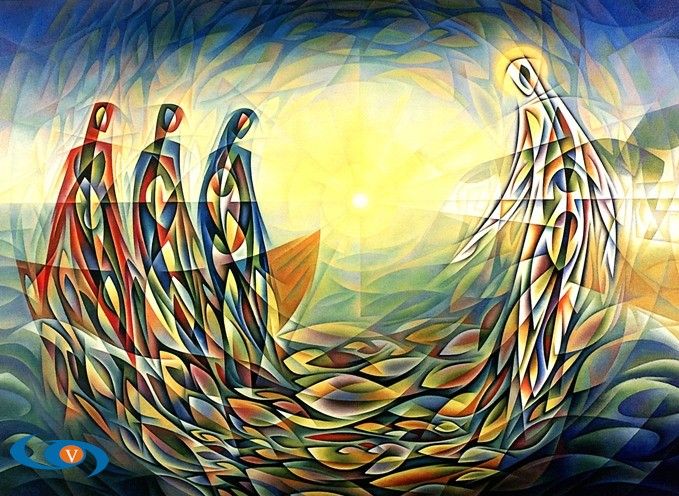
We see a circular, radiating structure. The artist builds the composition around a central circle, read as the sun, with shards of color rippling outward like water rings on the sea. The effect feels kaleidoscopic, facets of bright color assembling into a unified whole. The painting has a luminous effect similar to a stained glass window.

On the left, three figures are huddled in a boat. Their forms are with sweeping, rhythmic lines and “patchwork” colors. They appear to be pulling up nets, filled with fish. On the right, a tall, elongated figure stands, glowing white, possibly on the shore.

The water is depicted through overlapping, scale-like shapes of fish in blue, teal and green, suggesting the movement of waves without using traditional realism. The fish shapes aren’t just in the “water” or the nets, they integrate into the forms of the three on the left and the one on the right, possibly tying or connecting them together. The geometric shapes wrap around above as well as below, in more pale, pastel-like colors, completing the connection between the figures in a circular shape.

A central, radiant sun-like orb sits between (and behind) the boat and figures, casting a golden light.

The style has a mandala-like geometry, and is certainly more impressionistic than naturalistic.

What do you feel? (SUBJECTIVE EMOTION)

As you look at this painting, think about the way it makes you feel. Do you easily recognize the figure, the boat, the landscape? Or are you struggling to make sense of the image? Are the colors pleasing and harmonious, or are they jarring and disturbing? Do you feel drawn into the painting, or is it keeping you away? Do you feel the artist has created a pleasing image, one that might be suitable in your home, work-place, or place of worship?

What do you wonder about?

As we often do, we wonder about the title of the work and the name of the artist. We wonder if our first impressions about the piece are correct. Is this about Jesus and his disciples, many of whom were fishermen?

The painting is called “The Miraculous Draught of Fishes” or “The Miraculous Catch” and was painted in 1978. The artist is John Reilly (1928 – 2010)1, an English oil painter and potter who focused primarily on Christian themes. John and his wife, Elspeth Henderson, set up a pottery studio on the Isle of Wight. Reilly specialized in distinctive, brightly colored ceramics, mainly plaques and tiles using subtle, jewel-like colors and geometric patterns. As he developed his own painting style he incorporated the jewel-tones, and tile-like patterns into his work as very distinctly his own. Additionally (possibly inspired by the potters turning wheel), many of his paintings have a circular motif, with patterns revolving around some central focal point.

What story is Reilly capturing in this painting? There are several scripture passages where Jesus, walking along the sea shore, talks to his disciples. Matthew 4: 18-22, Mark 1:16-20, and Luke 5:1-11 all tell the story of Jesus calling his disciples to “fish for people”. But in John 21:1-14, Jesus appears to the disciples after he is resurrected.

1 After these things Jesus showed himself again to the disciples by the Sea of Tiberias; and he showed himself in this way. 2 Gathered there together were Simon Peter, Thomas called the Twin, Nathanael of Cana in Galilee, the sons of Zebedee, and two others of his disciples. 3 Simon Peter said to them, “I am going fishing.” They said to him, “We will go with you.” They went out and got into the boat, but that night they caught nothing.
4 Just after daybreak, Jesus stood on the beach; but the disciples did not know that it was Jesus. 5 Jesus said to them, “Children, you have no fish, have you?” They answered him, “No.” 6 He said to them, “Cast the net to the right side of the boat, and you will find some.” So they cast it, and now they were not able to haul it in because there were so many fish. 7 That disciple whom Jesus loved said to Peter, “It is the Lord!” When Simon Peter heard that it was the Lord, he put on some clothes, for he was naked, and jumped into the sea. 8 But the other disciples came in the boat, dragging the net full of fish, for they were not far from the land, only about a hundred yards off.
9 When they had gone ashore, they saw a charcoal fire there, with fish on it, and bread. 10 Jesus said to them, “Bring some of the fish that you have just caught.” 11 So Simon Peter went aboard and hauled the net ashore, full of large fish, a hundred fifty-three of them; and though there were so many, the net was not torn. 12 Jesus said to them, “Come and have breakfast.” Now none of the disciples dared to ask him, “Who are you?” because they knew it was the Lord. 13 Jesus came and took the bread and gave it to them, and did the same with the fish. 14 This was now the third time that Jesus appeared to the disciples after he was raised from the dead. John 21:1-14

Reilly has depicted Jesus as glowing, adorned in white. Although there are not 7 disciples in the boat, as described in the scripture, these are clearly disciples fishing. And while there may not be 153 fish in the nets in this painting, there are clearly so many that the nets are full.

Why 153? This number is rich in symbolism. Mathematically, 153 is the sum of all the whole numbers from 1 to 17 (1+2+3+…+17 = 153). Seventeen itself has symbolic resonance, seen as a prime number representing the Messiah. Some scholars believe that, at the time John’s Gospel was written, there were thought to be 153 nations in the known world.

Father Patrick van der Vorst says, “In other words, the miraculous catch is a sign that Christ came for everyone, to draw all peoples and nations to himself. But this universal mission unfolds one person at a time… one fish at a time. Just as Jesus stood on the shore in today’s passage, inviting his disciples to cast their nets, so we too are called to stand at the water’s edge of people’s lives. inviting, encouraging, and gently leading them to God.” 2

The fish, in the painting, flow from Jesus to the disciples in the boat, indicating blessings flow from Christ and God, to us. The rainbow colors of the fish indicate the diversity of those who are caught in the net by the disciples of Jesus.

What do you think?

Let me know what you think of this painting. It is neither realistic, not abstract, but rather a form of stylized Expressionism3. “[Expressionism]’s typical trait is to present the world solely from a subjective perspective, distorting it radically for emotional effect in order to evoke moods or ideas”. Expressionist artists have sought to express the meaning of emotional experience rather than physical reality. There seems to certainly be a lot of emotional experience going on here. What are you feeling when you look at this painting? (Revisit step 2.) What do you think the artists feelings were? Do you think they are similar to your feelings?

John Reilly has four paintings in the Methodist Collection of Modern Art. There is a book “The Painted Word”4 which has collected 50 of Reilly’s paintings and his thoughts on each.

Reilly says, about his paintings, “My paintings are not concerned with the surface appearance of people or things, but try to express something of the fun­damental spiritual reality behind this surface appearance. I try to express in visible form the oneness and unity of this invisible power, binding all things into one whole. I try to express some­thing of the universal and timeless truths behind the stories of the Bible.

Dwell on this for a moment. What do you think about his approach to painting? About this approach to understanding the Bible and the teachings of Christ? Does this painting make the scriptural story it represents more approachable? Feel free to comment below.

  1. https://en.wikipedia.org/wiki/John_Reilly_(painter) ↩︎
  2. https://christian.art/daily-gospel-reading/john-21-1-14-2025/ ↩︎
  3. https://en.wikipedia.org/wiki/Expressionism ↩︎
  4. https://books.google.com/books/about/The_Painted_Word.html?id=tKOOQwAACAAJ ↩︎

Carve Your Name

“Carve your name on hearts, not on marble” – Charles Spurgeon

What do you see? (OBJECTIVE OBSERVATION)

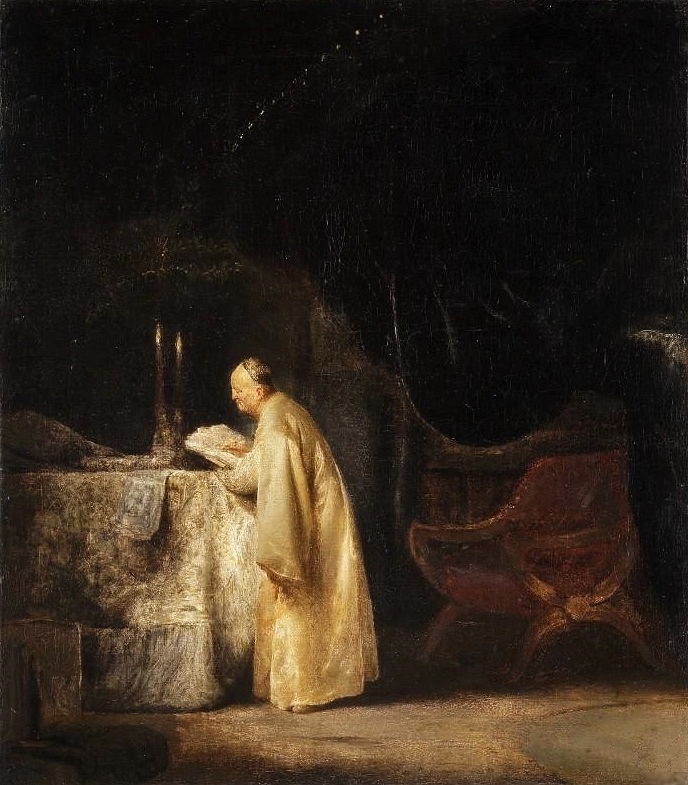
The painting is rather dark in most places. It is hard to decipher details, even when enlarged on your screen. Click on the image to take a closer look at a larger version of the image.

Still, the subject is surrounded by a dark and hard to see place setting. What we can see is unadorned. There seems to be a series of dots overhead and they line up in the direction of what looks like black, or dark draping. Below that, on the edge of the light, is a chair and possibly a wall.

The subject is a man, elderly, in a white robe, wearing a skull cap or maybe a yarmulka. He is holding, or maybe writing in, a book or on a tablet. His arm rests on a table, or maybe an altar. The table is draped with an ornate cloth, and possibly a runner or some other vestment as well. Also on this table are two candles, lit, which seem to be the source of light that illuminates the man and a portion of the room that he is in.

Where is the man’s attention drawn? Is he at all distracted by his surroundings? What might his facial expression and his body expression be conveying about what he is doing?

What do you feel? (SUBJECTIVE EMOTION)

Share with us, in the comment section below, what you feel about this painting. Are you at peace, or anxious about what is going on? Are you curious about what he is doing? Do you feel that you are welcome to be watching him, or do you think he would be annoyed or secretive about what he is doing?

What do you wonder about?

Who is this person? What is he doing? If he’s writing, what has he written?

Those would be my first questions, but, as usual, let’s start with What is the name of this painting? (That always helps us out.) “Zechariah in the Temple”. That’s a good start to answering the above question. It also helps us understand where this painting depicts. The Temple.

Zechariah has multiple spellings1, including Zachariah and Zacharias. To further confuse the issue, Zechariah (or a variation of that name) is the most frequently occurring name in the Bible2 (55 verses). So which Zechariah is the subject of this painting? Let’s ask the artist.

Who is the artist? Jan Lievens3 (1607 – 1674) was a Dutch artist, who was an associate and contemporary of Rembrandt. He painted both portraits and history paintings, many of which were of biblical subjects.

The subject of this particular painting, Zechariah4, was the father of John the Baptist. He was a Jewish priest in both the New Testament of the Bible, and in the Quran. He is venerated in both Christianity and Islam. He is the husband of Elizabeth (cousin of Mary, mother of Jesus), who conceived a child in her old age.

Let’s consider two scriptural passages about Zechariah, that may help us understand what is happening in this painting. The first is Luke 1:13, 1:19-20.

13 But the angel said to him, “Do not be afraid, Zechariah, for your prayer has been heard. Your wife Elizabeth will bear you a son, and you will name him John.

19 The angel replied, “I am Gabriel. I stand in the presence of God, and I have been sent to speak to you and to bring you this good news. 20 But now, because you did not believe my words, which will be fulfilled in their time, you will become mute, unable to speak, until the day these things occur.”

So Zechariah was unable to speak because he did not believe the angel Gabriel. The second scripture to consider is Luke 1:59-64.

59 On the eighth day they came to circumcise the child, and they were going to name him Zechariah after his father. 60 But his mother said, “No; he is to be called John.” 61 They said to her, “None of your relatives has this name.” 62 Then they began motioning to his father to find out what name he wanted to give him. 63 He asked for a writing tablet and wrote, “His name is John.” And all of them were amazed. 64 Immediately his mouth was opened and his tongue freed, and he began to speak, praising God.

What we see in this scene is the mute Zechariah, at the altar of his temple, writing the name of his son, John, on a tablet. John, then, is the messenger who became John the Baptist, heralding the coming of the Messiah.

Names have power. They reflect the love that the parents have for the child, but they can also be a blessing, or a burden, as the child grows. Many people select a moniker, nickname or alias by which they are known. That is because a name is part of a person’s identity, often for life. Some people who feel their given name does not truly reflect who they are at a given moment, will change their name (informally or legally) to reflect their new self. Women sometimes take on the last name of their husband to reflect their new relationship. In some cases last names are modified with a hyphen, joining together the names of both parents, to reflect the ancestral relationship the child has to both family lines. A person might also change their name to reflect a new relationship in their faith journey, such as Cassius Clay changing his name to Muhammad Ali5 when he joined the Nation of Islam, Or Steven Demetre Georgiou (Cat Stevens) who changed his name to Yusuf Islam.

God makes a big deal about names, scripturally. God told Adam to name the animals in the Garden of Eden. And God changed the names of people whose lives God changed: Abram to Abraham, Sarai to Sarah, Jacob to Israel. Jesus changed Simon’s name to Peter6. And Saul changed his name to Paul after he was converted.

In more modern culture, people have changed their name for a variety of reasons, most often to reflect their true identity. Singers Sting (Gordon Matthew Thomas Sumner) and Eminem (Marshal Bruce Mathers III), artist Banksy (unconfirmed birth name, changed to remain anonymous), playwright Molière (Jean-Baptiste Poquelin), author Voltaire (François-Marie Arouet), Olympic Gold Medalist Cailyn Marie Jenner (William Bruce Jenner) and politician JD Vance (James Donald Bowman and then James David Hamel, changed to reflect his family relationships instead of his birth parent relationship) to name a few.

The importance of naming is exemplified in the story of Zechariah and his son John. Lievens found this moment especially important. He filled the focal point of the painting with a soft, tender light. He simplified everything around Zechariah in order to draw focus to the important event that is taking place, namely the writing of John’s name.

If you are at all familiar with Rembrandt’s paintings you may have easily mistaken this one as having been painted by him. Lievens and Rembrandt were contemporaries. They were both born in Leiden, trained with Pieter Lastman in Amsterdam, and shared a studio for five years. They strongly influenced one another in their early years. They shared sensitivity to light and the quiet dignity of their figures.

The Baptist preacher Charles Spurgeon had this to say about the importance of names and their reflection of identity: “A good character is the best tombstone. Those who loved you and were helped by you will remember you when forget-me-nots have withered. Carve your name on hearts, not on marble.”

What do you think?

Let me know what your thoughts are about this painting, its story, and the associated scripture. Or let me know what you think of Jan Lievens as a painter. Notably not as well known as Rembrandt, but possibly as good at presenting a strong story through light and character.

  1. https://en.wikipedia.org/wiki/Zechariah_(given_name) ↩︎
  2. https://rsc.byu.edu/vol-14-no-2-2013/confusing-case-zacharias ↩︎
  3. https://en.wikipedia.org/wiki/Jan_Lievens ↩︎
  4. https://en.wikipedia.org/wiki/Zechariah,_father_of_John_the_Baptist ↩︎
  5. https://en.wikipedia.org/wiki/Muhammad_Ali ↩︎
  6. 42 He brought Simon to Jesus, who looked at him and said, “You are Simon son of John. You are to be called Cephas” (which is translated Peter). John 1:42 and 17 And Jesus answered him, “Blessed are you, Simon son of Jonah! For flesh and blood has not revealed this to you, but my Father in heaven. 18 And I tell you, you are Peter, and on this rock I will build my church…” Matthew 16:17-18 ↩︎

Any Given Sunday

8 Remember the sabbath day, and keep it holy. 9 Six days you shall labor and do all your work. 10 But the seventh day is a sabbath to the LORD your God; you shall not do any work—you, your son or your daughter, your male or female slave, your livestock, or the alien resident in your towns. 11 For in six days the LORD made heaven and earth, the sea, and all that is in them, but rested the seventh day; therefore the LORD blessed the sabbath day and consecrated it. Exodus 20:8-11 NRSV

What do you see? (OBJECTIVE OBSERVATION)

Let us challenge ourselves, shall we? Let‘s make sure we don’t get too literal here, because if we do, in the case of THIS painting we might say we see…

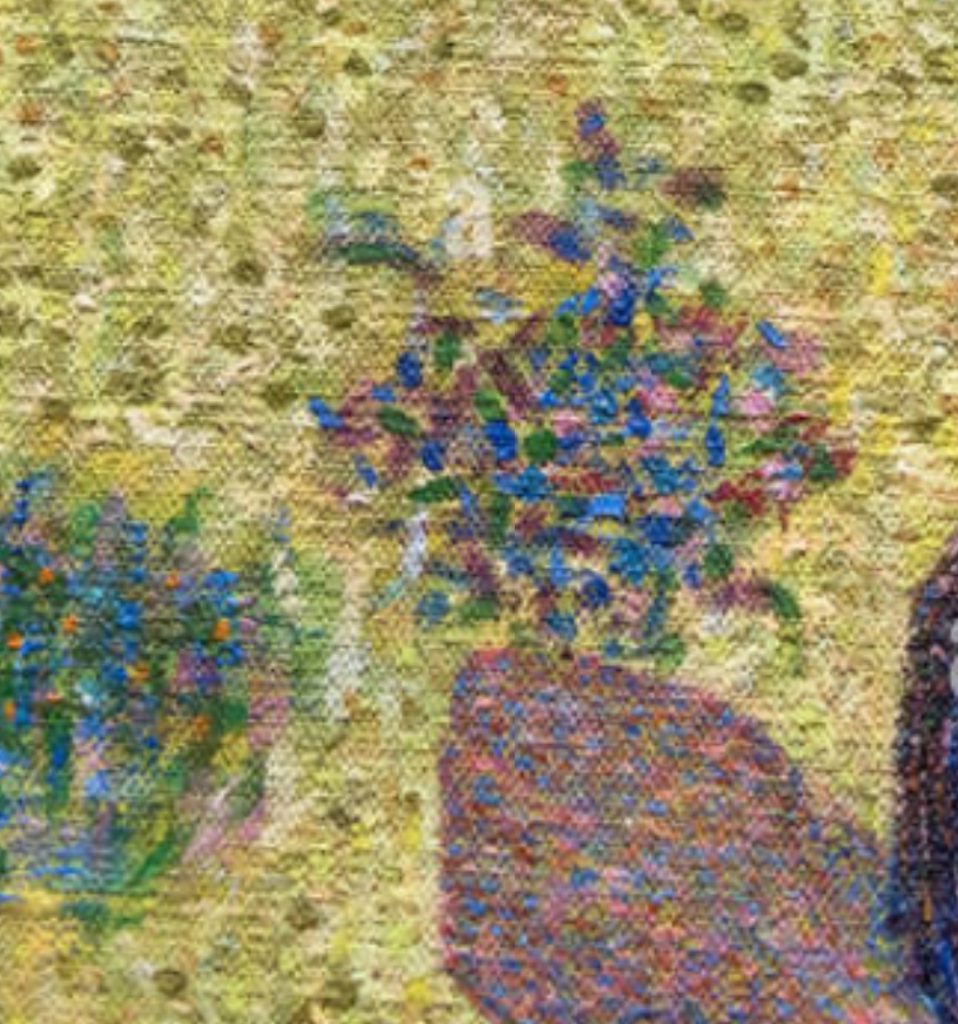
DOTS. Lots of colorful dots of paint. Red and yellow and blue and green and brown and ….

Can you find these dots in the painting above?

But we’re not being THAT literal. So what do you see in the painting. Look it over, think about what you see in this painting.

Click on the top painting to take a closer look. The dots of paint combine optically in the human eye to perceive single shades or hues. They are precisely placed to form this painting.

We may see many different people relaxing in a park by the river. On the right, a fashionable couple, the woman with the sunshade and the man in his top hat, are on a stroll. On the left, another woman who is also well dressed extends her fishing pole over the water. There is a small man with the black hat and thin cane looking at the river, A few dogs, far away one white dog has a brown head, a woman knitting, a man playing a trombone, two soldiers standing at attention as the musician plays, and a woman hunched under an orange umbrella. The artist also painted a man with a pipe, a woman under a parasol in a boat filled with rowers, and a couple admiring their infant child.

Some of the characters are doing curious things. The lady on the right side has a pet monkey on a leash. Almost everyone here is caught in a still pose, except for the child in the orange dress skipping off into the trees, the man on the far left playing trombone, and the furious little dog at the lower right. Many people are in the shade, either under parasols, or under trees.

One more thing to observe, that is unusual about this painting. There is a border around the whole painting, created in contrasting color so as to stand out.

What do you feel? (SUBJECTIVE EMOTION)

Does the painting make you feel anxious and excited, or is it calming? Is there a restful feeling about this painting?

Do you feel curious or intrigued by the style and method of the painting and the way the artist used many dots of paint to “fool your eye” into seeing people and objects?

Do you want to join these folks in their enjoyment of the park, maybe to stroll along with them, to listen to the music or watch what is going on in the river?

What do you wonder about?

What is the name of this painting?Un dimanche après-midi à l’Île de la Grande Jatte” which is French and translates in English to A Sunday Afternoon on the Island of La Grande Jatte.

Who is the artist? Georges-Pierre Seurat, known as Georges Seurat. He lived from 1859 to 1891 and lived in Paris, France. He was a French post-Impressionist1 artist, and his developed painting techniques gave form to Neo-Impressionism2.

When was this painted? The work was painted from 1884-1886, with several studies having been done during that time. The completed work is 6.6 ft by 9.8 ft and is composed of millions of dots of paint of uniform size, carefully placed on the canvas. Seurat was impressed by the color theories of Chevreul3, Rood4 and others, and adapted this scientific research into his paintings. This form of painting is called Pointilism5.

Where is the Island of La Grande Jatte?6 The island is located in the Seine river at the gates of Paris. In the late 1800’s the island was a place of resting and recreation, a place for Parisian society to leisurely enjoy on Sunday, their day off.

Most everyone in the painting has their gaze off to the left, watching something in the river. Whose gaze is directed differently? Look for the girl in the white dress. Who is she looking at? Is it the observer of the painting? Are we being invited to join everyone in relaxing at the park?

What about the edge of the painting? After painstakingly painting this beautiful scene, why did Seurat paint a contrasting frame around it? The painting, for the 1886 exhibition, had a white frame, something then unusual for exhibited art. The stark contrast between the pointillism of the painting and the white frame was something Seurat wanted to soften, so he added the contrasting border of pointillist colors for this reason.

Georges Seurat died at the relatively young age of 317. He left us with a wealth of engaging art and a new perspective on how we look at the world.

What do you think?

1 Again he entered the synagogue, and a man was there who had a withered hand. 2 They watched him to see whether he would cure him on the sabbath, so that they might accuse him. 3 And he said to the man who had the withered hand, “Come forward.” 4 Then he said to them, “Is it lawful to do good or to do harm on the sabbath, to save life or to kill?” But they were silent. 5 He looked around at them with anger; he was grieved at their hardness of heart and said to the man, “Stretch out your hand.” He stretched it out, and his hand was restored. 6 The Pharisees went out and immediately conspired with the Herodians against him, how to destroy him. Mark 3:1-6 NRSV

What do we do on any given Sunday? Do we work? Do we play? Do we worship? Do we serve others? Father Patrick van der Vorst says, “All four Gospels highlight the significance of the Sabbath, a day of rest and worship deeply rooted in Jewish tradition. Jesus, as a faithful Jew, observed the Sabbath and emphasized its importance, but He also redefined its purpose. In Mark’s Gospel reading, Jesus heals a man on the Sabbath, challenging the Pharisees’ rigid interpretation of the Law. They had turned the Sabbath into a day of burdensome rules rather than one of joyful worship and service to God. Jesus reminds us that the Sabbath is meant to restore, heal, and bring life, not impose unnecessary restrictions. For Christians, this principle translates to Sunday as our day of worship and rest, where we honor God through the Eucharist and community worship.”8

In today’s society (as possibly back in the late 1800’s) people are constrained in ways that prevent them from keeping Sunday as a day of rest and worship. But we can still be mindful, and find alternate ways to keep God’s commandment. Is there another day of the week that you find time to “rest and worship”? Is there a day (or day’s) that you can act in service to someone, the way Jesus did, helping someone in need? Maybe you volunteer in a soup kitchen, or deliver Meals on Wheels to shut-ins. Possibly you work at a thrift store, whose proceeds go to mission work. Some take an annual opportunity to work on housing for the needy through groups like Habitat for Humanity. Others might be available for disaster assistance work throughout the world when needed. All of these things might impact your regular sabbath day of rest and worship, but it is still honoring God in the world.

What do you think about the Sabbath? What do you think about “A Sunday Afternoon on the Island of La Grande Jatte”? Share your thoughts in the comment area below.

Footnotes and further reading

  1. https://en.wikipedia.org/wiki/Post-Impressionism ↩︎
  2. https://en.wikipedia.org/wiki/Neo-Impressionism ↩︎
  3. https://en.wikipedia.org/wiki/Michel_Eug%C3%A8ne_Chevreul#Chevreul’s_work ↩︎
  4. https://en.wikipedia.org/wiki/Ogden_Rood#Legacy ↩︎
  5. https://en.wikipedia.org/wiki/Pointillism ↩︎
  6. https://en.wikipedia.org/wiki/%C3%8Ele_de_la_Jatte ↩︎
  7. https://en.wikipedia.org/wiki/Georges_Seurat#Death ↩︎
  8. https://christian.art/daily-gospel-reading/mark-3-1-6-2025/ ↩︎

Horror in the sky

What do you see? (OBJECTIVE OBSERVATION)

There is a lot to look at, isn’t there? A man, older, maybe, with a long white beard and a balding head. He is high up in the air. Is he falling? Is he levitating? Several creatures surround him. Are there 8 or 9? Some are winged. Some are scaled. Some are toothed. Some have snouts, claws, hands, tails, clubs. Are they lifting him up? Are they pulling him down? What else do you notice about the creatures?

He is wearing a robe of some sort. What do you think that means? Did you notice the halo? One of the creatures seems to be trying to pull it off of his head.

And what do you see about the landscape? What is next to the group? What is in the distance? What is below them?

All of this is important to the artist, and it is important to us, so make note. We’ll come back to it soon.

Comment below in the comment section with your OBSERVATIONS about what you see. It is helpful to write down all of your observations so that you can refer back to them. It is a good exercise and it also helps other in noticing things that they may not have seen the first time they look at this painting. Go ahead. Then come back here an continue on.

Our next question is …

What do you feel (SUBJECTIVE EMOTION) when you look at this painting? Do you feel fear? Fear for the man being attacked by the creatures? Are you repulsed by the creatures? Do you feel fear for the people in the countryside beyond, and maybe hope that the man is saving them from the creatures? Look at this man’s face. He is not afraid, nor is he repulsed. Why is that? Do you feel awe at his bravery? Is he a hero? What do you feel about this painting?

Mark 10:21

17 As he was setting out on a journey, a man ran up and knelt before him, and asked him, “Good Teacher, what must I do to inherit eternal life?” 18 Jesus said to him, “Why do you call me good? No one is good but God alone. 19 You know the commandments: ‘You shall not murder; You shall not commit adultery; You shall not steal; You shall not bear false witness; You shall not defraud; Honor your father and mother.’ ” 20 He said to him, “Teacher, I have kept all these since my youth.” 21 Jesus, looking at him, loved him and said, “You lack one thing; go, sell what you own, and give the money to the poor, and you will have treasure in heaven; then come, follow me.” 22 When he heard this, he was shocked and went away grieving, for he had many possessions. Mark 10:17-22

St. Anthony of Egypt

What do you wonder about? (A time to question)

Who is this man? The halo and the monastic robes should indicate that he is someone saintly, and in fact he is Anthony the Great1 or Anthony of the Desert or Anthony the Hermit. He lived 251-356 CE.

What else do we know about him? “The Life of Anthony”2, written in Greek in 360, tells the biographical story of Anthony, a holy man who was inspired by the Gospel of Mark to “sell what you have and give to the poor”. Anthony is considered by some to be the first Christian monk/hermit living in the desert mountains west of the Nile river.

Who painted the painting? This, to me, is a fascinating thing about this artwork. “The Torment of St. Anthony” was painted by Michelangelo3 in 1487-88, the Italian sculptor who created marvelous sculpture of David and lots of other classical Renaissance masterpieces. It is the first of only a very few paintings the master artist did. But (wait for it), this was done when he was only 12 or 13 years old! WHAT!! He was serving an apprenticeship at the workshop of Domenico Ghirlandaio and painted a close copy of an engraving by Martin Schongauer [“The Temptation of St. Anthony” 1470-75]

This image has an empty alt attribute; its file name is 543px-Schongauer_Anthony-226x300.jpg
The Temptation of St. Anthony

If you click on the engraving you will go to the full size image on the wikipedia page. You can see the differences between the Schongauer engraving and the Michelangelo painting. What did Michelangelo do to enhance the original? He added background detail (like a river and a boat and buildings), and scales to the creatures. I suspect, living in Florence, Italy, he had very little experience with deserts and much experience with ships and fish.

What about Anthony the Great inspired Shongauer and Michelangelo to illustrate this scene from his life? One of the torments that “Life of Anthony” describes is the devil afflicting Anthony with boredom, laziness, and the phantoms of women, which he overcame by the power of prayer, after which he moved to one of the tombs near his native village. There it was that the Life records those strange conflicts with demons in the shape of wild beasts, who inflicted blows upon him, and sometimes left him nearly dead. Anthony is said to have elevated up over the desert where the phantoms had tormented him but ultimately he overcame them.

The Temptation of St. Anthony

What Do You Think (Time To Reply)

  • What do you think about Michelangelo’s work at 12-13 years old? Was he a prodigy?
  • What does this type of art say about Christianity? About the life of Anthony? About piety and faithfulness?
  • What do you like or dislike about this style of art (Renaissance)?
  • What do you think about the creatures?
  • What do you think about St. Anthony and his efforts at being a monk?

Here are some other things to research if interested.

The life of St. Anthony is very interesting. Start with the Wikipedia article on his life. In particular look at his reasons for becoming a hermit, and his difficulties in staying a hermit. After his parents died, he placed his sister with a group of Christian virgins. Then, he became an ascetic. Research what an “ascetic”4 is. And then try to understand this contradiction: “Thus, a colony of ascetics was formed, who begged Anthony to come forth and be their guide in the spiritual life. Eventually, he yielded to their importunities and, about the year 305, emerged from his retreat. To the surprise of all, he appeared to be not emaciated, but healthy in mind and body.”

At any rate, according to “Life”, St. Anthony lead a very interesting life, none the least of which was depicted in Michelangelo’s painting.

Share your thoughts in the comments below.

Footnotes

  1. https://en.wikipedia.org/wiki/Anthony_the_Great ↩︎
  2. https://en.wikipedia.org/wiki/Anthony_the_Great#Life_of_Anthony ↩︎
  3. https://en.wikipedia.org/wiki/Michelangelo ↩︎
  4. https://en.wikipedia.org/wiki/Asceticism ↩︎