I am approaching this post differently from my ususal layout. We’re going to talk about ICONOCLASM which, for us, is appropriate, because what addresses the conjunction of FAITH and ART more than destroying art for your beliefs?
First, we should define a few things.
What is an ICON? With regard to religious images, “An icon (from Ancient Greek εἰκών (eikṓn) ‘image, resemblance’) is a religious work of art, most commonly a painting, in the cultures of the Eastern Orthodox, Oriental Orthodox, Catholic, and Lutheran churches. The most common subjects include Jesus, Mary, saints, and angels. Although especially associated with portrait style images concentrating on one or two main figures, the term also covers most of the religious images in a variety of artistic media produced by Eastern Christianity, including narrative scenes, usually from the Bible or the lives of saints.”1
This is a classic definition, and there are many texts that discuss the history of religious icons and the denominations that venerate them.
Other modern uses of the term “icon” include:
- (in computing) an image used in a graphical interface.
- (cultural icon)
- (Pop icon) a celebrity, character, or object whose exposure in pop culture constitutes a defining characteristic of a given society or era
- (Architectural icon) a groundbreaking or unique building
- a pictogram
But we are disregarding these latter definitions in this discussion. We will be sticking to “religious work of art” definition, even though we may be extending it past the Byzantine era into our modern era. And may even apply it to some non-religious art, where it is impacted by “Iconoclasm”.
What is ICONOCLASM?
“The belief in the importance of the destruction of icons and other images or monuments, often for religious or political reasons. Those who engage in or support iconoclasm are called iconoclasts.”2 Iconoclasm does not generally encompass the destruction of the images of a specific ruler (or military figure) after their death or overthrow. For example, the defacing and vandalism of the tomb of my ancestor Baron Ralph Neville3 would not be considered iconoclasm.
Christian icons began to be created an venerated as early as the second century. (Some legends claim that Pilate had an image of Jesus created, but this has been largely debunked).

The image of Christ Pantocrator (Almighty) was one of the first images of Christ developed in the Early Christian Church and remains a central icon of the Eastern Orthodox Church. The oldest known surviving example of the icon of Christ Pantocrator was painted in encaustic on panel in the sixth or seventh century.
The Icon of Christ and Abbot Mena is a Coptic painting on wood and was found in the Apollo monastery in Bawit, Egypt. It is dated to the second half of the 6th century


Andrei Rublev (c. 1360 – c. 1430) was a Russian artist considered to be one of the greatest medieval Russian painters of Orthodox Christian icons and frescoes. The only work authenticated as entirely his is the icon of the Trinity (c. 1410)
These are some of the most iconic (something that is seen as a cultural icon) icons created throughout the East. There were many more, but a significant number have not survived. Why is that? While early Christian churches venerated the created images of Jesus and the saints as a means of drawing people into closer relationship with God and Christ, there began to be rumblings in the Eastern Orthodox churches about the use of icons as being idolatrous.
You shall not make for yourself an idol, whether in the form of anything that is in heaven above, or that is on the earth beneath, or that is in the water under the earth. Exodus 20:4
Do not turn to idols or make cast images for yourselves: I am the LORD your God. Leviticus 19:4
you shall drive out all the inhabitants of the land from before you, destroy all their figured stones, destroy all their cast images, and demolish all their high places. Numbers 33:52
“Cursed be anyone who makes an idol or casts an image, anything abhorrent to the LORD, the work of an artisan, and sets it up in secret.” All the people shall respond, saying, “Amen!” Deuteronomy 27:15
Since we are God’s offspring, we ought not to think that the deity is like gold, or silver, or stone, an image formed by the art and imagination of mortals. Acts 17:29
The early Christian church Synod of Elvira endorsed iconoclasm with the canon “Pictures are not to be placed in churches, so that they do not become objects of worship and adoration.”4 Early church theologians cited scripture from the Pentateuch (the first five books of the Jewish and Christian Scriptures) as justification for, at the least removing, and at the most destroying, images of Jesus and the saints. The justification was that images (sculptures as well as paintings) might be venerated to the point of becoming idols, which Mosaic law strictly prohibits.
What do you think about sacred images being idolized? Do you carry a prayer card with Warner Salman’s “Head of Christ”  in your wallet or purse? Do you bow or kneel at a statue of Mary? Do you wear a medal of a saint, praying to it for aid or intercession? These things may or may not be idolatrous, but Eastern Orthodox Christians of the Byzantine Era would say so, and would seek to destroy them.
My thoughts on this, while understanding the dangers of idolatry and the potential for making an image more important than God or Christ, I agree with the artist Rene Magritte when he painted “The Treachery of Images” as a statement that “Art is not ‘the thing’. Only the thing is the thing.”.5
The Byzantine Era of iconoclasm
The Byzantine Empire was the Eastern most part of the Roman Empire and survived the fall of the Roman Empire in the 5th century . It existed from 306 to 1453 CE. Christianity was the state religion. There were two periods in the Byzantine Empire where iconoclasm was a predominant expression of the Christian Church. The First Iconoclasm, as it is sometimes called, occurred between about 726 and 787, while the Second Iconoclasm occurred between 814 and 842. According to the traditional view, Byzantine Iconoclasm was started by a ban on religious images promulgated by the Byzantine Emperor Leo III the Isaurian, and continued under his successors. It was accompanied by widespread destruction of religious images and persecution of supporters of the veneration of images.6
Throughout the era the Byzantine Empire was regularly in contact with other Arab nations, either through war or trade. Islamic iconoclasm may or may not have had an impact on the Eastern Christian church and their iconoclasm. Islamic iconoclasm went further and rejected any depictions of living people or animals, not only religious images. This is evident in Islamic architectural design, where no vines, leaves, flowers, birds or animals adorn structures, only geometric designs. This is called Aniconism.

A mid 9th century Psalter illustration shows John the Grammarian rubbing out a painting of Christ with a pole and sponge, similar to the one offered to Christ on the cross.
By the end of the 9th century, Byzantine Iconoclasm was fading. But it certainly was not the end of iconoclasm.
Protestant Reformation Iconoclasm
In the early 1520’s, reformers called for the removal of images from churches. Martin Luther argued that the mental picturing of Christ when reading the Scriptures was similar in character to artistic renderings of Christ.
Calvinist reformers encouraged the removal of religious images, resulting in the Bildersturm, roughly translated as ‘attack on the images or statues’. During these spates of iconoclasm, Catholic art and many forms of church fittings and decoration were destroyed in unofficial or mob actions by Calvinist Protestant crowds as part of the Protestant Reformation. Most of the destruction was of art in churches and public places.7
Once the revolt proper had started, there were many instances of clearing churches, some still unofficial and disorderly, but as cities became officially Protestant, increasingly undertaken by official order, altars, to which Calvinists took strong exception, were typically completely removed, and some large churches, like Utrecht Cathedral, were vandalized or covered up.


The pre-Reformation sculpture, Dead Christ was discovered in 1954 beneath the floor of Mercer’s Chapel. The iconoclasts did some damage to the face, but the feet, arms and crown of thorns are gone. 8
20th and 21st century Iconoclasm
While iconoclasm continues on through the years into the 21st century, the nature of the vandalism and destruction of art, while still backed by religious and political beliefs, has shifted focus. Art has become more secular, yet it still reveals something about human faith.
#/media/File:D%C3%BCrer_Alte_Pinakothek.jpg)
The self portrait of Albrecht Dürer, painted in 1500, presents the artist as Christ. In 1805 it became part of the Bavarian Collection and hangs in Alte Pinakothek in Munich, Germany. It so distressed an unknown visitor that in 1905 the eyes were gouged out by a hatpin. It has since been restored.

On 10 March 1914 Mary Richardson, a British suffragette, entered the National Gallery in London to attack a painting by Velázquez, the Rokeby Venus, using a chopper she smuggled into the gallery.
She wrote a brief statement explaining her actions to the WSPU which was published by the press:
“I have tried to destroy the picture of the most beautiful woman in mythological history as a protest against the Government for destroying Mrs Pankhurst, who is the most beautiful character in modern history. Justice is an element of beauty as much as colour and outline on canvas.
— ”Miss Richardson’s Statement”. ‘The Times. London. 11 March 1914.
The canvas was later fully restored.9

Some contemporary artists use iconoclasm as a statement about art. In 2018, the anonymous artist Banksy stunned onlookers when he shredded his Girl with Balloon (2006) after it was purchased at Sotheby’s New York. Banksy confirmed that he was responsible for the shredding (by way of a mechanical device he had hidden inside the frame) and gave the altered piece a new name, Love Is in the Bin.
See a video of the auction and shredding here.
Contemporary art destruction
In March of 2025, Greek Parliament Member Nikolaos Papadopoulos targeted and damaged artist Christophoros Katsadiotis’s works, on display at the national gallery in Athens, decrying them as “blasphemous.”
Papadopoulos, a conservative Parliament member representing Greece’s far-right and ultra-religious Niki Party, accessed the group show The Allure of the Bizarre late Monday morning, March 10, and took down four of Katsadiotis’s etchings depicting Saint Christopher, Saint George, the Virgin Mary, and Jesus Christ. Papadopoulos shattered the protective glass of two etchings, claiming that the works slipped from his hands.10
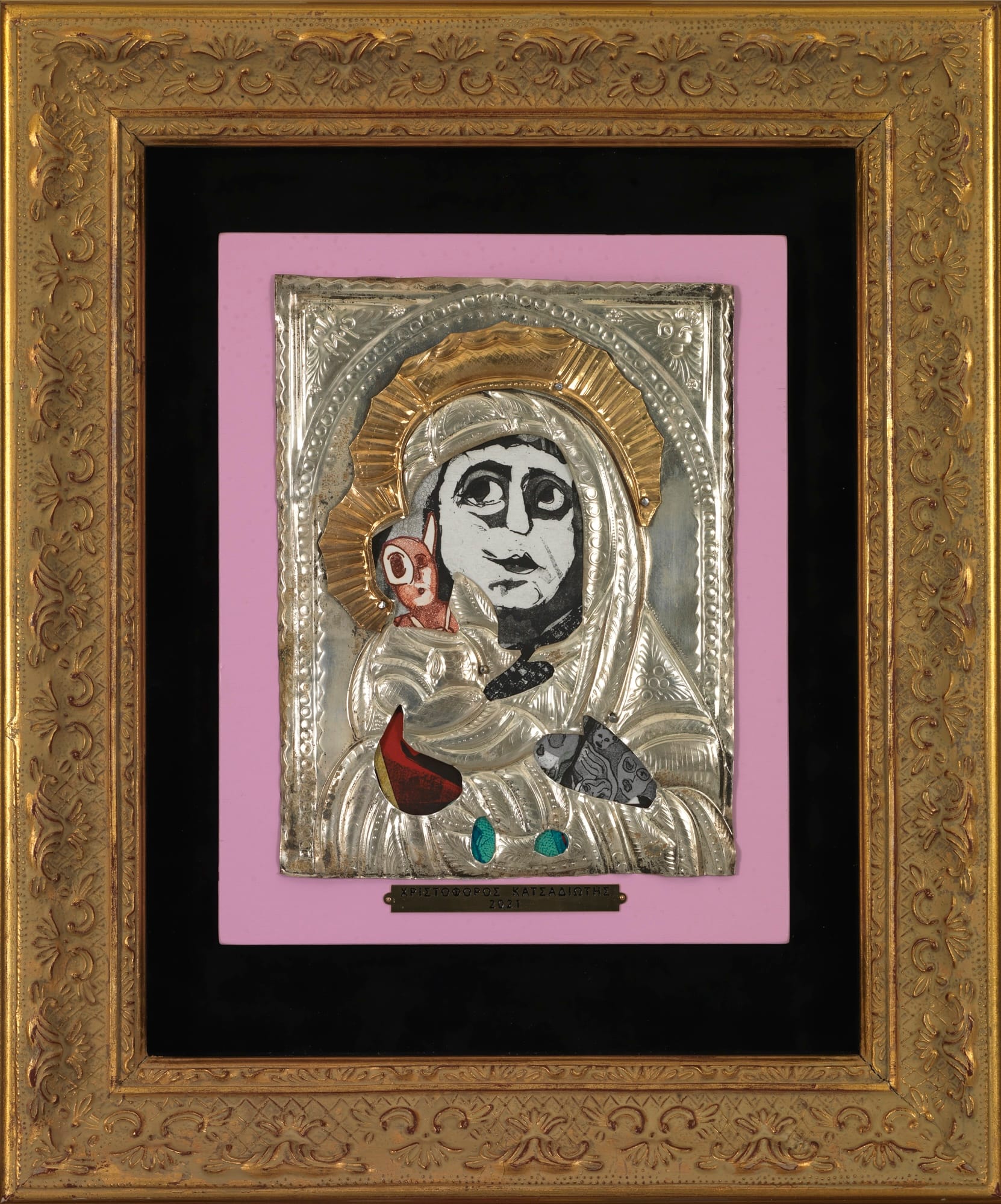
One day after the incident, the artist Katsadiotis stated that “it is worth considering how society (politics) uses religion as a tool to control and corral the masses with threats, fear and obscurantism.” The museum underscored that it “unequivocally condemns” any act of vandalism, violence, and any attempts at censorship that threaten the freedom of artistic expression.
In August of 2025, following a political decision statewide to remove painted crosswalks on all public streets throughout Florida, a similar directive caused planned and approved sidewalk art in Burns Court, Sarasota to be completely removed without the artists knowledge.

Art that had been commissioned by the city. It was a major tourist draw and attracted artists and culture lovers year round.
While the art itself was not political nor religious, the impetus for removing it was. Beginning with clashes over rainbow painted crosswalks, which showed support for LGBTQ+ issues and rights, the politically conservative legislature and Governor demanded they be removed as “public nuisances”. The removal extended beyond crosswalk art to include any art on surfaces that were walked on or driven on (even if approved by the city or local authority). The artists in Sarasota have filed legal notices against Sarasota and the state of Florida FDOT.11 The art cannot be recovered, but will the artists preserve their right to create public art when commissioned?
What do you think?
What do you think about the destruction of art? Is it justified? Is it ethical? If a work of art goes against your faith beliefs, is it OK to destroy or damage it? How offensive must a work of art be to bring a person to that level of destruction?
What about art in your place of worship? Have you looked around at any of the art that is displayed there? Should it be there, or should it be removed to another location so as to not interfere with your faith and worship?
Is religious art idolatrous, or does it bring you into closer relationship with God? Does religious art inform you in new ways about your faith? Does it challenge you? If a work spoke out in ways that do not conform to your beliefs, or understandings about your faith, should it be removed? Altered? Vandalized? Destroyed?
Does art, of any type, whether sacred or secular, bring value to your faith journey? If it offends you, do you have the obligation (or even the right) to destroy it?
Feel free to express your thoughts in the comment section below.
If you or someone you know would like to receive notification about these posts (about once every 24 days), subscribe at http://eepurl.com/i78iLU
Subscriptions cost nothing but ensure that you know when a new post is published on the website. You can always access the website (even without subscribing), but subscribing helps me know how many people are connecting to my posts, and it is a nice prompt to you to check out the latest. Thank you for following along.
- https://en.wikipedia.org/wiki/Icon ↩︎
- https://en.wikipedia.org/wiki/Iconoclasm ↩︎
- https://en.wikipedia.org/wiki/File:Highly-damaged_tomb_of_Ralph_Neville,_2nd_Baron_Neville_de_Raby_and_his_wife,_Alice_de_Audley,_in_Durham_Cathedral.jpg ↩︎
- https://web.archive.org/web/20120716202800/http://faculty.cua.edu/pennington/Canon%20Law/ElviraCanons.htm#:~:text=36.%C2%A0%C2%A0%C2%A0%C2%A0%20Pictures%20are%20not%20to%20be%20placed%20in%20churches%2C%20so%20that%20they%20do%20not%20become%20objects%20of%20worship%20and%20adoration. ↩︎
- https://bonafides.kjunkins.com/wordpress/this-is-not-a-pipe/ ↩︎
- https://en.wikipedia.org/wiki/Byzantine_Iconoclasm ↩︎
- https://en.wikipedia.org/wiki/Beeldenstorm ↩︎
- https://www.theguardian.com/artanddesign/2013/oct/06/art-under-attack-tate-review ↩︎
- https://en.wikipedia.org/wiki/Mary_Richardson ↩︎
- https://hyperallergic.com/athens-museum-removes-artworks-vandalized-by-far-right-lawmaker/ ↩︎
- https://www.mysuncoast.com/2026/03/23/sarasota-erased-downtown-art-without-public-notice-artists-now-seek-damages/ ↩︎