Speaking for God

“and your sons and your daughters shall prophesy”

What do you see? (OBJECTIVE OBSERVATION)

In a dark, quiet space, with just enough light to read, sits an elderly woman intently reading a large book. She is wrapped in a heavy cloak with a fur collar, and has her head covered. Looking closely at the details, she is sitting on an ornately carved chair. A place for the wealthy or learned then, not for the poor or uneducated.

You can click on the image above to look at a high resolution image that you can zoom in on. But let’s look at some of the finer details.
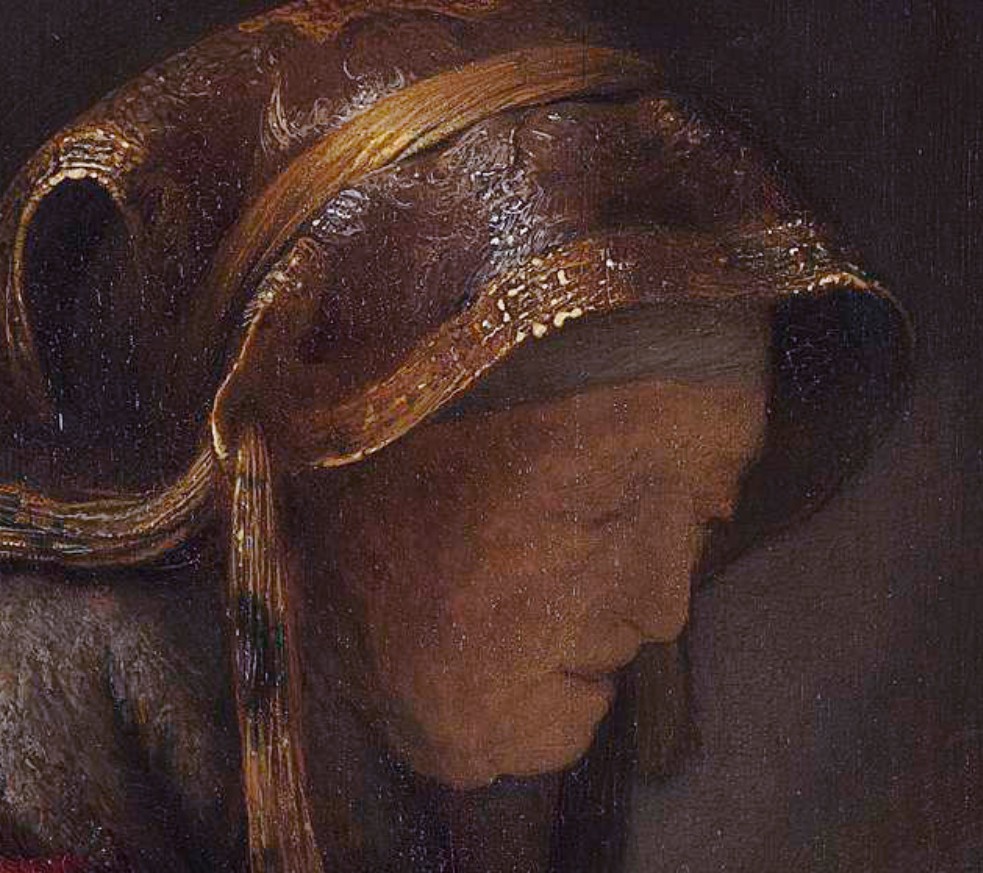
Her grey hair discreetly peeks out from under her headpiece. You can see that her face is worn with age, but she is intently studying the book she holds in her hands. Is there the slightest of smiles on her lips?
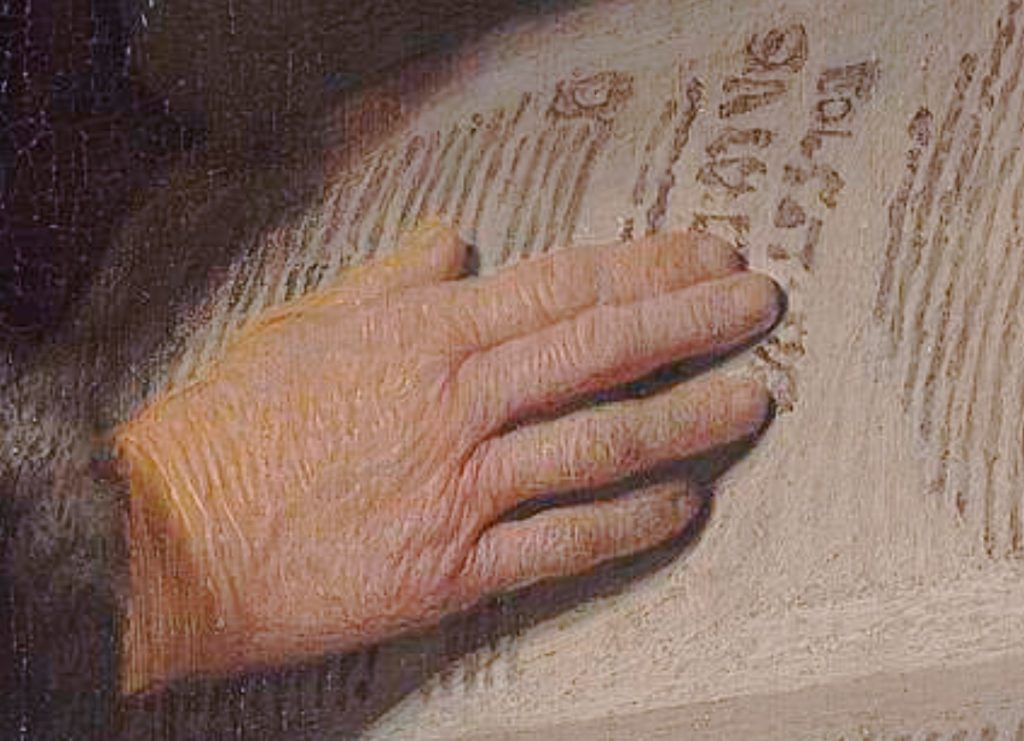
Her aged hands follow along on the text she is reading, lovingly caressing the page. We cannot read or guess what she is reading, but it seems important to her. Notice the incredible detail painted of this hand; the wrinkles and skin texture.

What do you feel? (SUBJECTIVE EMOTION)

Reflect on the feelings and emotions that you have as you meditate on this painting. Are you anxious or peaceful? Is the scene welcoming or hostile? Are you drawn in, or do you feel uninvited?

Take a moment now to meditate on the painting and think about how it makes you feel.

What do you wonder about?

Who is this woman? It could have been my mother, or my grandmother. There are no strong clues as to her identity. We may wonder what she is reading, since it is illegible to us (and the book has no apparent pictures). And we might wonder where she is, since there are few details about location. There is only the chair and the illumination.

Let’s start with the artist. Rembrandt Harmenszoon van Rijn (15 July 1606 – 4 October 1669) known by the singular name Rembrandt1, was a Dutch painter and is generally considered one of the greatest artists in the history of Western art. Approximately three hundred of his paintings survive today. This painting was created rather early in Rembrandt’s career, just a half dozen years after he opened his studio, and just three after his first sale of a painting.

Originally called “An Old Woman Reading”, and then later “Rembrandt’s Mother” (who was often a model for his paintings), it eventually became titled “The Prophetess Anna” based on several other of his paintings where Anna was the identified subject.2 3

So who is the Prophetess Anna4?

36 There was also a prophet, Anna the daughter of Phanuel, of the tribe of Asher. She was of a great age, having lived with her husband seven years after her marriage, 37 then as a widow to the age of eighty-four. She never left the temple but worshiped there with fasting and prayer night and day. 38 At that moment she came, and began to praise God and to speak about the child to all who were looking for the redemption of Jerusalem. Luke 2:36-38

As with many of the master works of the Dutch Golden Age5 6, the subject was imagined in contemporary clothing, not the historically accurate garb of a first century Middle Eastern Jewish woman. So out of context of the title and associated other works of the artist, it might not be apparent that this is the Prophetess Anna.

What is a “Prophetess”?

A prophetess is a female prophet. The word prophet comes from the Greek word prophetes, which means “spokesman.” A prophet in the Bible is a person who proclaims God’s Word and therefore speaks for God—a spokesman for God. A prophetess was, therefore, a spokeswoman for God. The faithful prophet or prophetess was one who, regardless of whether or not he or she was listened to, spoke everything God said to speak.7

There are several prophetesses mentioned in scripture, women who proclaimed God’s word.

Miriam, sister to Moses and Aaron

20 Then the prophet Miriam, Aaron’s sister, took a tambourine in her hand; and all the women went out after her with tambourines and with dancing. 21 And Miriam sang to them:
“Sing to the LORD, for he has triumphed gloriously;
horse and rider he has thrown into the sea.” Exodus 15:20-21

Deborah

4 At that time Deborah, a prophetess, wife of Lappidoth, was judging Israel. 5 She used to sit under the palm of Deborah between Ramah and Bethel in the hill country of Ephraim; and the Israelites came up to her for judgment. Judges 4:4-5

Huldah

14 So the priest Hilkiah, Ahikam, Achbor, Shaphan, and Asaiah went to the prophetess Huldah the wife of Shallum son of Tikvah, son of Harhas, keeper of the wardrobe; she resided in Jerusalem in the Second Quarter, where they consulted her. 2 Kings 22:14

22 So Hilkiah and those whom the king had sent went to the prophet Huldah, the wife of Shallum son of Tokhath son of Hasrah, keeper of the wardrobe (who lived in Jerusalem in the Second Quarter) and spoke to her to that effect. 2 Chronicles 34:22

The unnamed mother of Isaiah’s son

3 And I went to the prophetess, and she conceived and bore a son. Then the LORD said to me, Name him Maher-shalal-hash-baz; Isaiah 8:3

All were clearly called by God to proclaim God’s word, and the people, from kings and priests to all the people of Israel, listened to and highly respected the women who were God’s spokesperson.

The only named Prophetess of the New Testament is Anna, daughter of Phaneul. And if this seems important, it is. Anna confirms, publicly to Jesus’ parents Mary and Joseph, as spokesperson for God, that Simeon’s proclamation that the child Jesus was the promised Messiah.

A righteous and devout man approaches the parents, in the temple, and proclaims that He (the child) is the Messiah. And to put an exclamation point on it, God sends a prophetess to the parents right afterwards to confirm, with blessings from God, that this is true. “Praise be to God,” she proclaims. “This is the Messiah.”

Because Anna was known as a prophetess, and that she stayed in the temple fasting and praying all night and day, possibly for many years (indicated by her old age), her proclamations are joyfully accepted.

A woman, bringing God’s words to the world, being accepted as authoritative.

Is the painting of Anna, or just an old woman?

We cannot know for certain what Rembrandt intended. Like Anna from the scripture, she appears to us aged and knowledgeable. The book she holds in her hands is not intelligible to us, but she pours over it with rapt attention and apparent emotional connection and deep understanding. She knows what we yet do not. But the page is illuminated and therefore important. We must pay attention to both her presence and the news she brings us. We must listen for God’s word, brought to us by both prophets and prophetesses.

17 ‘In the last days it will be, God declares,
that I will pour out my Spirit upon all flesh,
and your sons and your daughters shall prophesy,
and your young men shall see visions,
and your old men shall dream dreams. Acts 2:17

This speech by Peter to the crowd at Pentecost who questioned the meaning of the signs and wonders, was a reciting of the Old Testament scripture Joel 2:28-29 proclaiming the pouring out of God’s Spirit. It affirms the prophecies (delivery of God’s words) from both men and women, young and old, and calls us to be listeners looking to discern God’s messages.

What do you think?

How has your perception of the Rembrandt painting “Anna the Prophetess” changed as you meditated on the painting and on the associated scripture? Do you see God calling both men and women to bring his word and work to the world? Some Jewish and Christian scripture specifies that temple or church leadership be done by men, yet scripture shows that God also calls women. What do you think of this possible discrepancy?

Please share your thoughts in the comments below.


If you or someone you know would like to subscribe to our occasional emails, 
Click Here


  1. https://en.wikipedia.org/wiki/Rembrandt ↩︎
  2. https://en.wikipedia.org/wiki/Tobit_and_Anna_with_the_Kid ↩︎
  3. https://www.nationalgallery.org.uk/paintings/rembrandt-anna-and-the-blind-tobit ↩︎
  4. https://en.wikipedia.org/wiki/Anna_the_Prophetess ↩︎
  5. https://en.wikipedia.org/wiki/Dutch_Golden_Age ↩︎
  6. https://en.wikipedia.org/wiki/Dutch_Golden_Age_painting ↩︎
  7. https://www.gotquestions.org/prophetess-Bible.html ↩︎
Carve Your Name

“Carve your name on hearts, not on marble” – Charles Spurgeon

What do you see? (OBJECTIVE OBSERVATION)

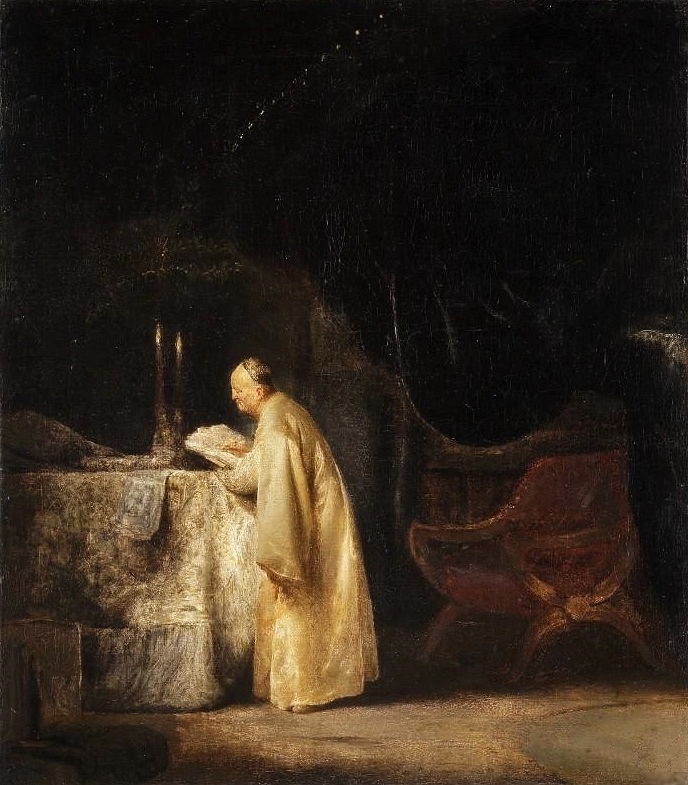
The painting is rather dark in most places. It is hard to decipher details, even when enlarged on your screen. Click on the image to take a closer look at a larger version of the image.

Still, the subject is surrounded by a dark and hard to see place setting. What we can see is unadorned. There seems to be a series of dots overhead and they line up in the direction of what looks like black, or dark draping. Below that, on the edge of the light, is a chair and possibly a wall.

The subject is a man, elderly, in a white robe, wearing a skull cap or maybe a yarmulka. He is holding, or maybe writing in, a book or on a tablet. His arm rests on a table, or maybe an altar. The table is draped with an ornate cloth, and possibly a runner or some other vestment as well. Also on this table are two candles, lit, which seem to be the source of light that illuminates the man and a portion of the room that he is in.

Where is the man’s attention drawn? Is he at all distracted by his surroundings? What might his facial expression and his body expression be conveying about what he is doing?

What do you feel? (SUBJECTIVE EMOTION)

Share with us, in the comment section below, what you feel about this painting. Are you at peace, or anxious about what is going on? Are you curious about what he is doing? Do you feel that you are welcome to be watching him, or do you think he would be annoyed or secretive about what he is doing?

What do you wonder about?

Who is this person? What is he doing? If he’s writing, what has he written?

Those would be my first questions, but, as usual, let’s start with What is the name of this painting? (That always helps us out.) “Zechariah in the Temple”. That’s a good start to answering the above question. It also helps us understand where this painting depicts. The Temple.

Zechariah has multiple spellings1, including Zachariah and Zacharias. To further confuse the issue, Zechariah (or a variation of that name) is the most frequently occurring name in the Bible2 (55 verses). So which Zechariah is the subject of this painting? Let’s ask the artist.

Who is the artist? Jan Lievens3 (1607 – 1674) was a Dutch artist, who was an associate and contemporary of Rembrandt. He painted both portraits and history paintings, many of which were of biblical subjects.

The subject of this particular painting, Zechariah4, was the father of John the Baptist. He was a Jewish priest in both the New Testament of the Bible, and in the Quran. He is venerated in both Christianity and Islam. He is the husband of Elizabeth (cousin of Mary, mother of Jesus), who conceived a child in her old age.

Let’s consider two scriptural passages about Zechariah, that may help us understand what is happening in this painting. The first is Luke 1:13, 1:19-20.

13 But the angel said to him, “Do not be afraid, Zechariah, for your prayer has been heard. Your wife Elizabeth will bear you a son, and you will name him John.

19 The angel replied, “I am Gabriel. I stand in the presence of God, and I have been sent to speak to you and to bring you this good news. 20 But now, because you did not believe my words, which will be fulfilled in their time, you will become mute, unable to speak, until the day these things occur.”

So Zechariah was unable to speak because he did not believe the angel Gabriel. The second scripture to consider is Luke 1:59-64.

59 On the eighth day they came to circumcise the child, and they were going to name him Zechariah after his father. 60 But his mother said, “No; he is to be called John.” 61 They said to her, “None of your relatives has this name.” 62 Then they began motioning to his father to find out what name he wanted to give him. 63 He asked for a writing tablet and wrote, “His name is John.” And all of them were amazed. 64 Immediately his mouth was opened and his tongue freed, and he began to speak, praising God.

What we see in this scene is the mute Zechariah, at the altar of his temple, writing the name of his son, John, on a tablet. John, then, is the messenger who became John the Baptist, heralding the coming of the Messiah.

Names have power. They reflect the love that the parents have for the child, but they can also be a blessing, or a burden, as the child grows. Many people select a moniker, nickname or alias by which they are known. That is because a name is part of a person’s identity, often for life. Some people who feel their given name does not truly reflect who they are at a given moment, will change their name (informally or legally) to reflect their new self. Women sometimes take on the last name of their husband to reflect their new relationship. In some cases last names are modified with a hyphen, joining together the names of both parents, to reflect the ancestral relationship the child has to both family lines. A person might also change their name to reflect a new relationship in their faith journey, such as Cassius Clay changing his name to Muhammad Ali5 when he joined the Nation of Islam, Or Steven Demetre Georgiou (Cat Stevens) who changed his name to Yusuf Islam.

God makes a big deal about names, scripturally. God told Adam to name the animals in the Garden of Eden. And God changed the names of people whose lives God changed: Abram to Abraham, Sarai to Sarah, Jacob to Israel. Jesus changed Simon’s name to Peter6. And Saul changed his name to Paul after he was converted.

In more modern culture, people have changed their name for a variety of reasons, most often to reflect their true identity. Singers Sting (Gordon Matthew Thomas Sumner) and Eminem (Marshal Bruce Mathers III), artist Banksy (unconfirmed birth name, changed to remain anonymous), playwright Molière (Jean-Baptiste Poquelin), author Voltaire (François-Marie Arouet), Olympic Gold Medalist Cailyn Marie Jenner (William Bruce Jenner) and politician JD Vance (James Donald Bowman and then James David Hamel, changed to reflect his family relationships instead of his birth parent relationship) to name a few.

The importance of naming is exemplified in the story of Zechariah and his son John. Lievens found this moment especially important. He filled the focal point of the painting with a soft, tender light. He simplified everything around Zechariah in order to draw focus to the important event that is taking place, namely the writing of John’s name.

If you are at all familiar with Rembrandt’s paintings you may have easily mistaken this one as having been painted by him. Lievens and Rembrandt were contemporaries. They were both born in Leiden, trained with Pieter Lastman in Amsterdam, and shared a studio for five years. They strongly influenced one another in their early years. They shared sensitivity to light and the quiet dignity of their figures.

The Baptist preacher Charles Spurgeon had this to say about the importance of names and their reflection of identity: “A good character is the best tombstone. Those who loved you and were helped by you will remember you when forget-me-nots have withered. Carve your name on hearts, not on marble.”

What do you think?

Let me know what your thoughts are about this painting, its story, and the associated scripture. Or let me know what you think of Jan Lievens as a painter. Notably not as well known as Rembrandt, but possibly as good at presenting a strong story through light and character.

  1. https://en.wikipedia.org/wiki/Zechariah_(given_name) ↩︎
  2. https://rsc.byu.edu/vol-14-no-2-2013/confusing-case-zacharias ↩︎
  3. https://en.wikipedia.org/wiki/Jan_Lievens ↩︎
  4. https://en.wikipedia.org/wiki/Zechariah,_father_of_John_the_Baptist ↩︎
  5. https://en.wikipedia.org/wiki/Muhammad_Ali ↩︎
  6. 42 He brought Simon to Jesus, who looked at him and said, “You are Simon son of John. You are to be called Cephas” (which is translated Peter). John 1:42 and 17 And Jesus answered him, “Blessed are you, Simon son of Jonah! For flesh and blood has not revealed this to you, but my Father in heaven. 18 And I tell you, you are Peter, and on this rock I will build my church…” Matthew 16:17-18 ↩︎