“Carve your name on hearts, not on marble” – Charles Spurgeon
What do you see? (OBJECTIVE OBSERVATION)
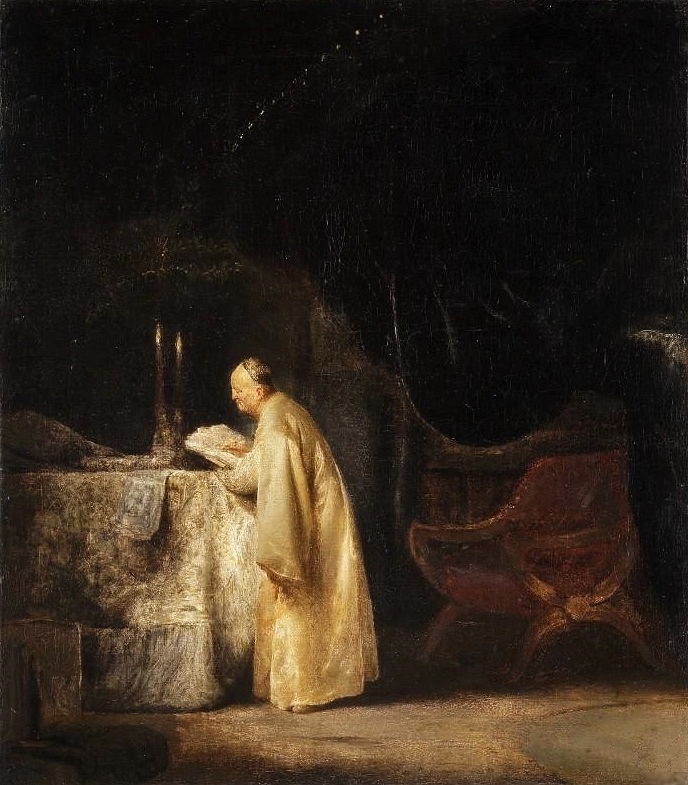
The painting is rather dark in most places. It is hard to decipher details, even when enlarged on your screen. Click on the image to take a closer look at a larger version of the image.
Still, the subject is surrounded by a dark and hard to see place setting. What we can see is unadorned. There seems to be a series of dots overhead and they line up in the direction of what looks like black, or dark draping. Below that, on the edge of the light, is a chair and possibly a wall.
The subject is a man, elderly, in a white robe, wearing a skull cap or maybe a yarmulka. He is holding, or maybe writing in, a book or on a tablet. His arm rests on a table, or maybe an altar. The table is draped with an ornate cloth, and possibly a runner or some other vestment as well. Also on this table are two candles, lit, which seem to be the source of light that illuminates the man and a portion of the room that he is in.
Where is the man’s attention drawn? Is he at all distracted by his surroundings? What might his facial expression and his body expression be conveying about what he is doing?
What do you feel? (SUBJECTIVE EMOTION)
Share with us, in the comment section below, what you feel about this painting. Are you at peace, or anxious about what is going on? Are you curious about what he is doing? Do you feel that you are welcome to be watching him, or do you think he would be annoyed or secretive about what he is doing?
What do you wonder about?
Who is this person? What is he doing? If he’s writing, what has he written?
Those would be my first questions, but, as usual, let’s start with What is the name of this painting? (That always helps us out.) “Zechariah in the Temple”. That’s a good start to answering the above question. It also helps us understand where this painting depicts. The Temple.
Zechariah has multiple spellings1, including Zachariah and Zacharias. To further confuse the issue, Zechariah (or a variation of that name) is the most frequently occurring name in the Bible2 (55 verses). So which Zechariah is the subject of this painting? Let’s ask the artist.
Who is the artist? Jan Lievens3 (1607 – 1674) was a Dutch artist, who was an associate and contemporary of Rembrandt. He painted both portraits and history paintings, many of which were of biblical subjects.
The subject of this particular painting, Zechariah4, was the father of John the Baptist. He was a Jewish priest in both the New Testament of the Bible, and in the Quran. He is venerated in both Christianity and Islam. He is the husband of Elizabeth (cousin of Mary, mother of Jesus), who conceived a child in her old age.
Let’s consider two scriptural passages about Zechariah, that may help us understand what is happening in this painting. The first is Luke 1:13, 1:19-20.
13 But the angel said to him, “Do not be afraid, Zechariah, for your prayer has been heard. Your wife Elizabeth will bear you a son, and you will name him John.
19 The angel replied, “I am Gabriel. I stand in the presence of God, and I have been sent to speak to you and to bring you this good news. 20 But now, because you did not believe my words, which will be fulfilled in their time, you will become mute, unable to speak, until the day these things occur.”
So Zechariah was unable to speak because he did not believe the angel Gabriel. The second scripture to consider is Luke 1:59-64.
59 On the eighth day they came to circumcise the child, and they were going to name him Zechariah after his father. 60 But his mother said, “No; he is to be called John.” 61 They said to her, “None of your relatives has this name.” 62 Then they began motioning to his father to find out what name he wanted to give him. 63 He asked for a writing tablet and wrote, “His name is John.” And all of them were amazed. 64 Immediately his mouth was opened and his tongue freed, and he began to speak, praising God.
What we see in this scene is the mute Zechariah, at the altar of his temple, writing the name of his son, John, on a tablet. John, then, is the messenger who became John the Baptist, heralding the coming of the Messiah.
Names have power. They reflect the love that the parents have for the child, but they can also be a blessing, or a burden, as the child grows. Many people select a moniker, nickname or alias by which they are known. That is because a name is part of a person’s identity, often for life. Some people who feel their given name does not truly reflect who they are at a given moment, will change their name (informally or legally) to reflect their new self. Women sometimes take on the last name of their husband to reflect their new relationship. In some cases last names are modified with a hyphen, joining together the names of both parents, to reflect the ancestral relationship the child has to both family lines. A person might also change their name to reflect a new relationship in their faith journey, such as Cassius Clay changing his name to Muhammad Ali5 when he joined the Nation of Islam, Or Steven Demetre Georgiou (Cat Stevens) who changed his name to Yusuf Islam.
God makes a big deal about names, scripturally. God told Adam to name the animals in the Garden of Eden. And God changed the names of people whose lives God changed: Abram to Abraham, Sarai to Sarah, Jacob to Israel. Jesus changed Simon’s name to Peter6. And Saul changed his name to Paul after he was converted.
In more modern culture, people have changed their name for a variety of reasons, most often to reflect their true identity. Singers Sting (Gordon Matthew Thomas Sumner) and Eminem (Marshal Bruce Mathers III), artist Banksy (unconfirmed birth name, changed to remain anonymous), playwright Molière (Jean-Baptiste Poquelin), author Voltaire (François-Marie Arouet), Olympic Gold Medalist Cailyn Marie Jenner (William Bruce Jenner) and politician JD Vance (James Donald Bowman and then James David Hamel, changed to reflect his family relationships instead of his birth parent relationship) to name a few.
The importance of naming is exemplified in the story of Zechariah and his son John. Lievens found this moment especially important. He filled the focal point of the painting with a soft, tender light. He simplified everything around Zechariah in order to draw focus to the important event that is taking place, namely the writing of John’s name.
If you are at all familiar with Rembrandt’s paintings you may have easily mistaken this one as having been painted by him. Lievens and Rembrandt were contemporaries. They were both born in Leiden, trained with Pieter Lastman in Amsterdam, and shared a studio for five years. They strongly influenced one another in their early years. They shared sensitivity to light and the quiet dignity of their figures.
The Baptist preacher Charles Spurgeon had this to say about the importance of names and their reflection of identity: “A good character is the best tombstone. Those who loved you and were helped by you will remember you when forget-me-nots have withered. Carve your name on hearts, not on marble.”
What do you think?
Let me know what your thoughts are about this painting, its story, and the associated scripture. Or let me know what you think of Jan Lievens as a painter. Notably not as well known as Rembrandt, but possibly as good at presenting a strong story through light and character.
- https://en.wikipedia.org/wiki/Zechariah_(given_name) ↩︎
- https://rsc.byu.edu/vol-14-no-2-2013/confusing-case-zacharias ↩︎
- https://en.wikipedia.org/wiki/Jan_Lievens ↩︎
- https://en.wikipedia.org/wiki/Zechariah,_father_of_John_the_Baptist ↩︎
- https://en.wikipedia.org/wiki/Muhammad_Ali ↩︎
- 42 He brought Simon to Jesus, who looked at him and said, “You are Simon son of John. You are to be called Cephas” (which is translated Peter). John 1:42 and 17 And Jesus answered him, “Blessed are you, Simon son of Jonah! For flesh and blood has not revealed this to you, but my Father in heaven. 18 And I tell you, you are Peter, and on this rock I will build my church…” Matthew 16:17-18 ↩︎