“And He’s allowed me to go up to the mountain. And I’ve looked over.” – Martin Luther King Jr.
What do you see? (OBJECTIVE OBSERVATION)
Pause for a while. Look at the painting, and when you do, do so in two ways. Glance at the painting casually. What catches your eye at first? What do you see right away?
Then, look at the painting more closely. Zoom in on it with your computer if you can. (Click on the image above to open a larger, zoomable version.) Look at the details, in the foreground, in the people and animals, in the field. Look at the background in detail. Notice things hidden in behind the main subject matter. Take your time and notice the subtle details.
Now, what do you see?
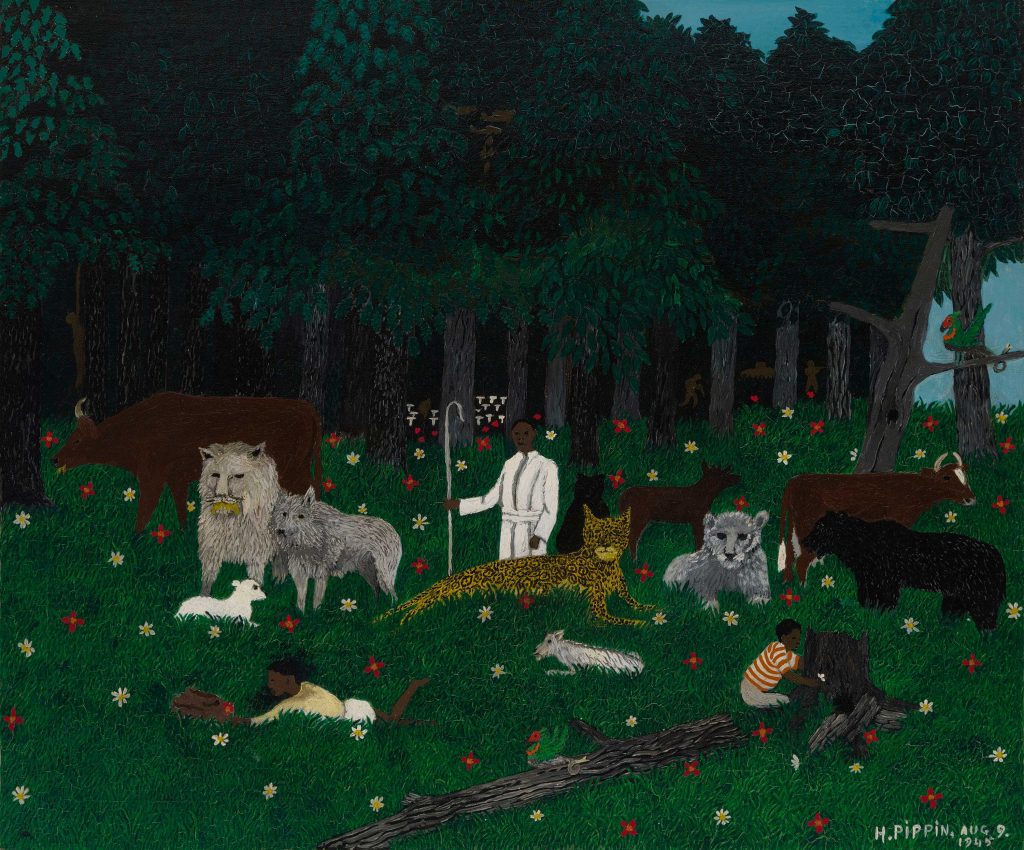
At first we see a grassy field with white and red flowers (maybe daisies and poppies). Standing in the dead center of this field is a brown man in a white robe. He is holding a shepherds crook, and is looking directly at us, the viewer. He is surrounded by a variety of animals, some tame, some wild. A bull, a cow, a sheep, a deer, a goat. Also a lion and lioness, a wolf, a leopard, two bears. In a tree to the right is a colorful winged animal, not quite a parrot. It has a tail like a mythical griffin. In the foreground, laying in the grass, are two children, also with brown skin. Maybe they are playing or exploring, but they are not seemingly concerned with the wild animals around them.
But then we venture into the woods in the background. In the dark woods behind the man with the crook are some white objects, lined up in rows like headstones, possible. Above this, in the forest leaves, are shadows of objects that look like airplanes dropping bombs on the graves below. To the right in the woods are some brown shadows, men, one looking like it is loading a rifle, the other as if he is shooting. Between them an object that looks like a tank. In the far left we find another brown shadow. This one looks horrifyingly like a person, hung by the neck from the trees.
What do you feel? (SUBJECTIVE EMOTION)
The painting may take you through a range of feelings. Think about those feelings for a few minutes and try to identify what you feel and why you feel it. Do the animals make you feel happy (or maybe scared because of the wild things)? Does it seem dangerous, or is it peaceable? They seem to be getting along. Are you afraid for the children? Or are you glad they are able to be playful among the animals? Are you curious about the man? Maybe he is there to keep everyone at peace.
But what about the woods behind? Is it frightening? Foreboding? Dangerous? Are you horrified by the lynched person?
What do you wonder about?
It’s hard to wonder about who the artist is or when the artist painted the picture when their name and date are written in the bottom right corner of the painting.
H. Pippin Aug 9. 1945
But who is H. Pippin? Horace Pippin (February 22, 1888 – July 6, 1946) was an American painter. The New York Times eulogized him as “the most important Negro painter” in American history”.1 Pippin was born in West Chester, PA (the town where I now live). He grew up interested in art, having won some art supplies after entering a contest. He served in the army during World War I in the all-Black unit known as the Harlem Hellfighters.2 He was shot in the right arm and earned a pension for life. He created several memoirs, one of which he drew illustrations for. He returned to West Chester and took up art, creating drawings burned into wood with a hot poker. Later he turned to painting on fabric.
What about this painting?
This painting is called Holy Mountain III. About 100 years after Edward Hicks (from neighboring Bucks County, PA) painted his series of (62) paintings called Peaceable Kingdom, Pippin picked up his brushes and painted a series of three paintings he called Holy Mountain. It is easy to see that Pippin was directly inspired by Hicks’ painting. There are many similarities.
Before we compare the two, let us reflect on the scripture that inspires Peaceable Kingdom/Holy Mountain.
6 The wolf shall live with the lamb,
the leopard shall lie down with the kid,
the calf and the lion and the fatling together,
and a little child shall lead them.
7 The cow and the bear shall graze,
their young shall lie down together;
and the lion shall eat straw like the ox.
8 The nursing child shall play over the hole of the asp,
and the weaned child shall put its hand on the adder’s den.
9 They will not hurt or destroy
on all my holy mountain;
for the earth will be full of the knowledge of the LORD
as the waters cover the sea. Isaiah 11:6-9
A later verse in Isaiah circles back to the Peaceable Kingdom of God:
The wolf and the lamb shall feed together,
the lion shall eat straw like the ox;
but the serpent—its food shall be dust!
They shall not hurt or destroy
on all my holy mountain,
says the LORD. Isaiah 65:25
These passages are part of the Bible’s description of the Peaceable Kingdom of God. The prophet Isaiah speaks of global peace and harmony; an era free of strife and hardship. Oppressor and oppressed, hunter and hunted, lie down with each other, absent of any danger or animosity. Children play peacefully without fear of harm. The peaceable kingdom is God’s Holy Mountain.
Isn’t it chilling that Isaiah lays out for us a place where all can be peaceable with others that, without God’s protection, would be a danger to each other? That a child can play near an asp’s den, a very poisonous and dangerous snake?
Edward Hicks (April 4, 1780 – August 23, 1849) was an American folk painter and distinguished Christian minister of the Society of Friends (a.k.a. “Quakers”). He became a notable Quaker because of his paintings. Some of his 62 paintings of the Peaceable Kingdom can be viewed at the following links. Take a moment to view them to see if you see some common elements.
Wolf & Lamb; Calf & Lion; Leopard & Kid; a little child. You might also see the lion eating straw, and possibly a child playing near a hole in the ground (representing the adders or asps den).
Now look back at Pippin’s Holy Mountain III painting. Are these same elements present in his painting? The main difference for Pippin is that the people in his painting are not white Europeans. Rather they are representative of Pippin and his family.
The other big difference is what Pippin does in the background story. You might guess that Pippin, from scripture alone, could have made Holy Mountain without having ever seen Hicks’ Peaceable Kingdom. However, Hicks does something interesting in the background of most of his Peaceable Kingdom paintings and Pippin has picked up on this. In the background Hicks places a metaphor for God’s Peaceable Kingdom. In the distance you can find a peaceable negotiation between Native Americans and the European settlers (in the form of William Penn). Hicks, as a Quaker minister, repeatedly reminds us that enemies need to come together in peace in God’s Kingdom.
Horace Pippin, on the other hand, reminds us of something completely different. In the periphery of God’s Holy Mountain, beyond the peace and safety, lie danger, war, persecution and death.
In a 2013 exhibition titled “Ashe to Amen: African Americans and Biblical Imagery” Pippin’s painting was featured. A commentator writes, “Pippin chose to foreground the Holy Mountain, demonstrating his hope that such a scene would one day be actualized. Rather than turning a blind eye to the painful realities of a sad and violent world, Pippin presents a vision of mankind moving out of the shadows and into the brilliant light of a peaceful clearing.”3
Pippin painted three versions of this scene. Holy Mountain I, Holy Mountain II and Holy Mountain III. He does something similar in the background of each, but the last is most expressive of Pippin’s connection to the scripture and his views of war as a threat to the Peaceable Kingdom of God. He shows us that outside of God’s peace there are always the dangers of war, violence and injustice. Very alarming is his reference to racial injustice, in the form of a lynched person. Throughout Pippin’s life racial lynching over 4,000 times between 1877 and 1950. 4
In respect to these three paintings, it seems that war is foremost in his mind. In the foreground the field is scattered with red flowers, poppies. Red poppies honor soldiers who died in combat or served in the armed forces. The soldiers, tanks, air bombings and graves, all in the background, reflect the profound experiences Pippin had as a soldier in WWI. Inscribed on each painting is a date, one that the viewer might think are the painting creation dates. Yet each is a significant date in the war: June 6, 1944 (Holy Mountain I) is D-Day, when the Allied forces landed on the beaches of Normandy; Dec. 7, 1944 (Holy Mountain II) is the date when Pearl Harbor was attacked; Aug. 9, 1945 (Holy Mountain III) is the day the atomic bomb was dropped on Nagasaki, Japan. Pippin draws us to those moments that are so clearly outside the peace of God.
Pippin might have been influenced by Hicks’ Peaceable Kingdom, but he called his paintings “Holy Mountain”, connecting more directly to scripture. At Pippin’s death in 1946, he left an unfinished fourth Holy Mountain painting. Though he painted many other works, both genre paintings and religious scenes, his hope for God’s peaceable Holy Mountain may have been on his heart. Many critics and art analysts suggest that the man central in these paintings, with dark skin, black hair and a shepherd’s crook, is Horace Pippin’s self portrait. Could Pippin be trying to show us the way to God’s Holy Mountain?
What do you think?
Feel free to comment below to share what you think about Horace Pippin’s painting of the Holy Mountain. What do you like about it? What do you not like about it? And what are those griffin-like birds in the trees of all three paintings? What is he saying with those? I have not found any online critiques that explain them. What do they mean to you?
Footnotes